English


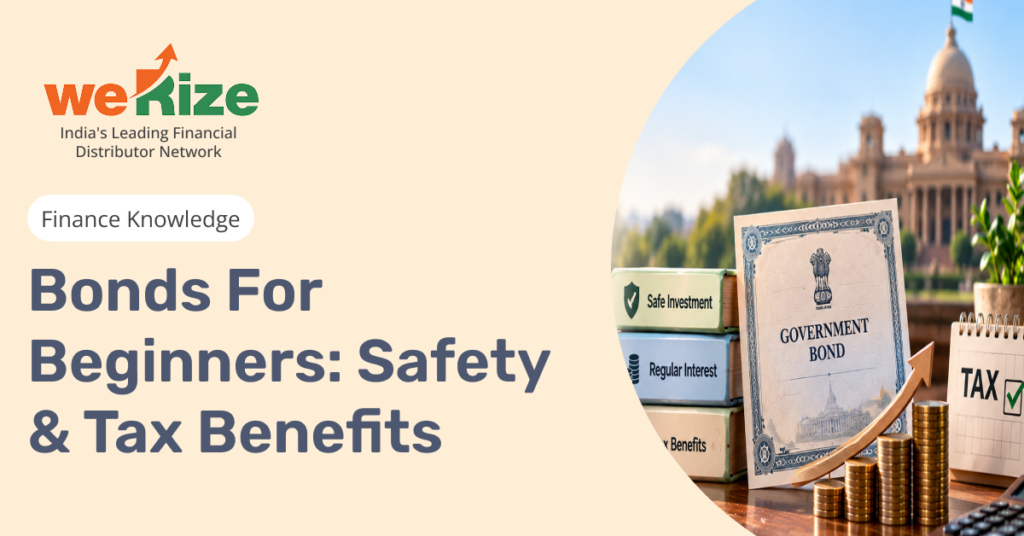


Many people want steady returns without sleepless nights. However, the stock market can feel scary at first. Therefore, many first-time investors look at bonds. Bonds are simple, predictable, and often safer than shares.
Moreover, bonds can also help you save tax. In this guide, we explain bond investment for beginners in plain words. Further, we cover tax-free bonds, tax benefits, and how safe bonds really are. Finally, we show you how to start in India. Let us begin.
What Is Bond Investment for Beginners?
A bond is a loan. You lend money to a government or a company. In return, they promise to pay you interest. Besides that, they promise to return your full money on a fixed date.
For example, you buy a bond worth ₹1,000. The issuer pays you interest every year. On the last date, you get your ₹1,000 back. Thus, you know what to expect from day one.
That is why bond investment for beginners is a smart starting point. Similarly, bonds suit people who like clear rules and steady income. In short, you become the lender, and the issuer becomes the borrower.
How Do Bonds Work?
Every bond has four main parts. First, the face value is the amount printed on the bond. Second, the coupon is the interest rate the issuer pays you. Third, the maturity date is the day you get your money back. Fourth, the issuer is the government or company that borrowed from you.
Let us take a simple example. You buy a bond with a face value of ₹10,000 and a coupon of 8%. As a result, you earn ₹800 every year. After five years, the issuer returns your ₹10,000.
Meanwhile, bonds also trade in the market. Their prices go up and down. Consequently, you can sell a bond before maturity. However, you may get more or less than you paid.
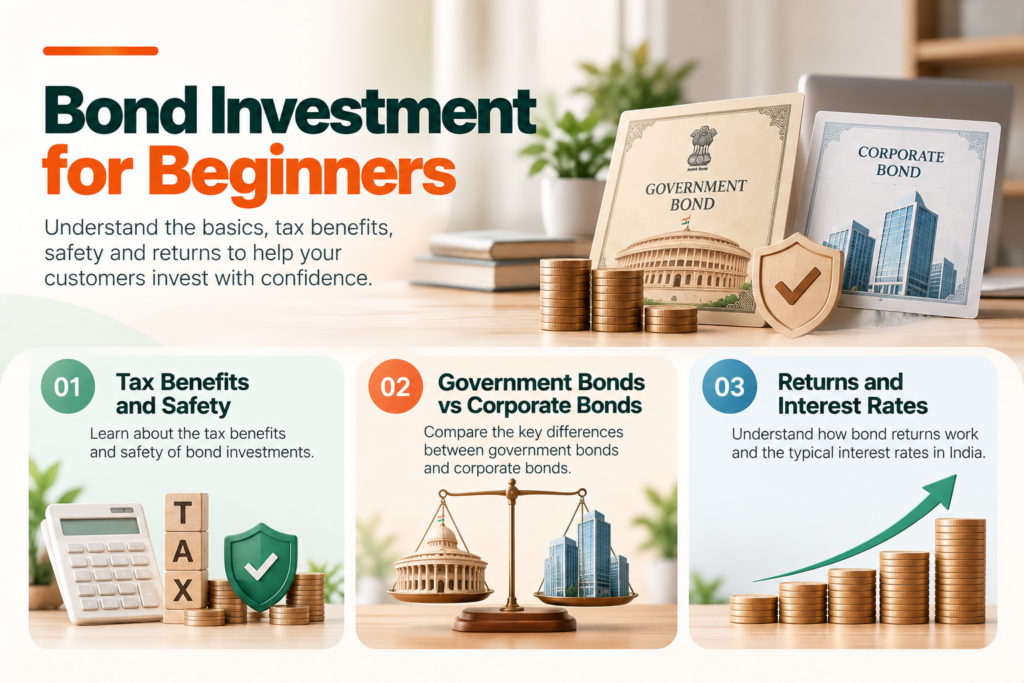
Why Consider Bonds as a Low-Risk Investment?
Bonds work well as a low-risk investment for three reasons.
- Fixed income: Most bonds pay interest on a set schedule.
- Priority in payment: If a company struggles, it pays bondholders before shareholders.
- Lower ups and downs: Bond prices move less than share prices.
Moreover, bonds balance your portfolio. When shares fall, bonds often stay steady. Similarly, they help you plan for goals like a child’s education or a home down payment.
Still, “low risk” does not mean “no risk.” As mentioned earlier, bonds carry some risks too. We cover them later in this guide.
Types of Bonds Beginners Can Invest In
India offers many bond types. Here are the common ones.
Government Securities (G-Secs). The central government issues these. Therefore, they are among the most trusted options.
State Development Loans (SDLs). State governments issue these to fund projects. Likewise, they carry a strong safety record.
Treasury Bills. These are short-term government papers. They mature in less than one year.
Corporate Bonds. Companies issue these to raise money. Generally, they pay higher interest than government bonds.
Tax-Free Bonds. Government-backed companies issue these. We explain them next.
Tax-Saving Capital Gain Bonds. Some people use these to save tax on property gains. Check the rules first, since they apply only in certain cases.
Tax-Free Bonds: What Are They?
Tax-free bonds are bonds whose interest you do not pay income tax on. Government-owned companies such as NHAI, REC, and PFC have issued them in the past. Thus, the interest you earn stays fully with you.
Here is a simple example. Suppose a tax-free bond pays 5.5%. If you are in the 30% tax slab, a taxable bond must pay about 8% to give you the same take-home return. Hence, tax-free bonds suit people in higher tax slabs.
However, note one point. The government has not issued new tax-free bonds for several years. Therefore, most investors buy them from the stock exchange, in the secondary market. Additionally, their prices there can differ from the face value.
Tax Benefits of Bond Investments
Now let us look at tax benefits in detail. Bond taxes depend on the bond type. Consequently, you should know the rules before you invest.
- Tax-free bonds: The interest is exempt from income tax.
- Government and corporate bonds: The interest is taxable at your slab rate.
- Selling before maturity: You may earn a capital gain, which is taxable.
- Capital gain bonds: These help you save tax on certain long-term property gains.
Further, corporate bond interest may face TDS. So always check your tax deducted in Form 26AS.
Besides that, tax rules change often. Therefore, please confirm current rules on the Income Tax Department website or with a tax advisor before you invest.
Bond Safety: How Safe Are Bonds?
Bond safety depends on who issues the bond. In other words, a stronger issuer means a safer bond.
- Government bonds carry very low default risk. The government backs them.
- Corporate bonds carry more risk. A company may fail to pay.
Credit ratings help you here. Agencies like CRISIL, ICRA, and CARE rate bonds. For example, AAA means the highest safety. Similarly, lower ratings mean higher risk.
For a high-safety choice, beginners should first look at AAA-rated or government bonds. Additionally, read the rating report before you buy. In fact, it takes only a few minutes.
Government Bonds vs Corporate Bonds for Beginners
Which one should you pick? Let us compare them side by side.
| Feature | Government Bonds | Corporate Bonds | Tax-Free Bonds |
| Safety | Very high | Medium to high, depends on rating | High, as PSUs issue them |
| Interest rate | Lower | Higher | Lower, but tax-free |
| Interest taxable? | Yes | Yes | No |
| Best for | Safety seekers | Higher income seekers | High tax slab investors |
| Ease of buying | Easy online | Needs some research | Buy on exchange |
As the table shows, each type has a purpose. Therefore, match the bond to your goal. Moreover, many investors mix two types.
Bond Returns and Interest Rates
Bond returns depend on the coupon and the price you pay. Also, interest rates in the economy affect bond prices.
Here is the simple rule. When interest rates rise, existing bond prices fall. Conversely, when interest rates fall, existing bond prices rise. Thus, if you hold a bond until maturity, price swings matter less.
Furthermore, look at the yield, not just the coupon. Yield shows your real return based on today’s price. For instance, a bond bought at a discount gives a higher yield. Similarly, one bought at a premium gives a lower yield.
Risks Beginners Should Know Before Investing in Bonds
Bonds are safer than many options. Still, you should know the risks.
- Credit risk: The issuer may fail to pay interest or principal.
- Interest rate risk: Rising rates can lower your bond’s price.
- Liquidity risk: You may struggle to find a buyer quickly.
- Inflation risk: Rising prices can reduce the value of your returns.
- Reinvestment risk: You may have to reinvest at lower rates later.
Because of these risks, never put all your money in one bond. Instead, spread it across issuers and maturities.
How to Choose Bonds Based on Risk and Tax Benefits
Follow these simple steps.
Step 1: Know your goal. Do you want safety, regular income, or tax savings? Your answer guides your choice.
Step 2: Check your tax slab. If you are in a high slab, tax-free bonds may suit you. Otherwise, taxable bonds with higher interest may work better.
Step 3: Check the credit rating. Prefer AAA or government bonds first.
Step 4: Match the maturity to your needs. Choose a date close to when you need the money.
Step 5: Compare yields. Look at the yield after tax. Only then can you compare fairly.
Moreover, start small. Later, add more as you learn.
How to Start Bond Investment in India
Starting is easier than you think. Follow these steps.
- Complete your KYC. You need PAN, Aadhaar, and a bank account.
- Open a demat account. Most bonds trade in demat form.
- Pick a platform. You can use RBI Retail Direct for government securities. Similarly, SEBI-registered brokers and online bond platforms offer corporate and tax-free bonds.
- Search and compare. Check the rating, yield, and maturity date.
- Place your order. Pay through your bank account.
- Track your investment. Note your interest dates and maturity date.
Additionally, use only SEBI-registered platforms. This step protects you from fraud.
Common Mistakes to Avoid as a Beginner Bond Investor
- Chasing high returns only. A very high rate often means very high risk.
- Ignoring credit ratings. Always check them first.
- Skipping the tax rules. Taxes can cut your real return.
- Buying one bond only. Spread your money instead.
- Forgetting the exit plan. Some bonds are hard to sell early.
- Trusting unverified sellers. Buy only from regulated platforms.
Overall, a little care avoids most beginner errors.
Conclusion
Bond investment for beginners does not need to feel hard. First, you lend money. Then, you earn steady interest. Finally, you get your money back at maturity.
Moreover, bonds offer safety and can offer tax benefits. Tax-free bonds suit higher-income investors. Similarly, government bonds suit those who want high safety. Meanwhile, corporate bonds suit those who accept a little more risk for higher income. To become a loan agent, sell RDs, FDs & FD credit cards, & to earn more, join WeRize & start your DSA journey. Start small, stay patient, and grow steadily.
So, set your goal, check ratings, and start small. In the end, patient and informed investing builds wealth over time.