English


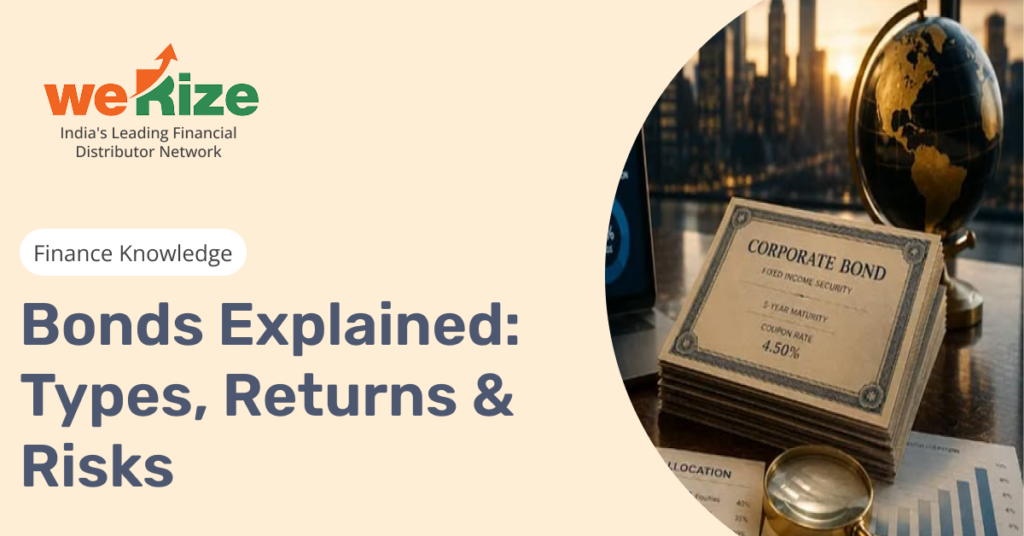




Many people in India save money in fixed deposits. However, bonds are another option that can give steady income. Moreover, they can add balance to your money plans.
If you are wondering how to invest in bonds in India, this guide will help. First, you will learn what bonds are. Next, you will see the types, returns, and risks. Finally, you will learn simple steps to start.
We have kept the language easy. Therefore, even a first-time investor can follow along.
What Are Bonds and How Do They Work?
A bond is a loan. You lend money to a company or the government. In return, they pay you interest at fixed times. Then, on the end date, they give your money back.
Here are the key terms:
- Face value: The amount you lend, for example ₹1,000 or ₹10,000.
- Coupon rate: The yearly interest the bond pays on its face value.
- Maturity date: The day the issuer returns your money.
- Issuer: The company or government that borrows the money.
For example, suppose you buy a bond with a ₹10,000 face value and a 7% coupon. As a result, you get ₹700 every year. Then, at maturity, you get back your ₹10,000.
Similarly, bonds trade in the market. Hence, their prices can go up or down before maturity.
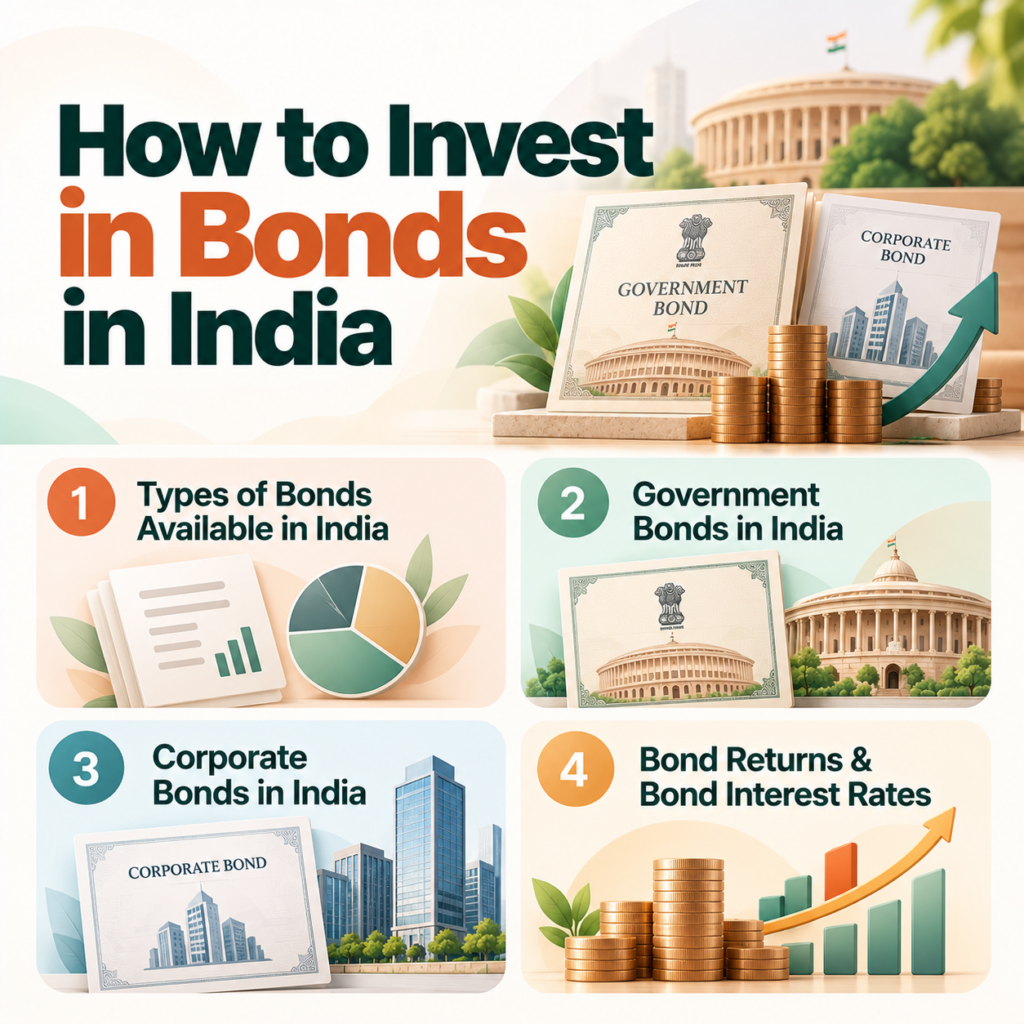
How to Invest in Bonds in India
Investing in bonds is easier now than before. Besides, you can start online in a few steps.
- Set your goal. First, decide why you want to invest. Some people want regular income. Others want safety.
- Open the right accounts. Next, you need a demat account and a bank account. In addition, complete your KYC.
- Choose a platform. For government bonds, you can use the RBI Retail Direct portal. Meanwhile, for corporate bonds, you can use a stockbroker or a SEBI-registered online bond platform.
- Check the bond details. Then, look at the coupon rate, maturity date, and credit rating.
- Place your order. After that, pay the amount and confirm the purchase.
- Track your bond. Finally, watch your interest credits and the maturity date.
Furthermore, you can also buy bonds through bond mutual funds or ETFs. Therefore, you do not need to pick each bond yourself.
Types of Bonds Available in India
India has many kinds of bonds. Let us look at the common ones.
- Government securities (G-Secs): The central government issues these. They are among the safest choices.
- State development loans (SDLs): State governments issue these to raise money.
- Treasury bills: These are short-term and mature in less than a year.
- Corporate bonds: Companies issue these to fund their business.
- Tax-free bonds: Some government-backed companies issue these. The interest was tax-free, but new issues are rare.
- Floating rate bonds: Their interest changes with a set benchmark.
- Zero-coupon bonds: These pay no regular interest. Instead, you buy them at a discount and get the full face value later.
In addition, some bonds are listed on stock exchanges. Consequently, you can sell them before maturity if you need cash.
Government Bonds in India
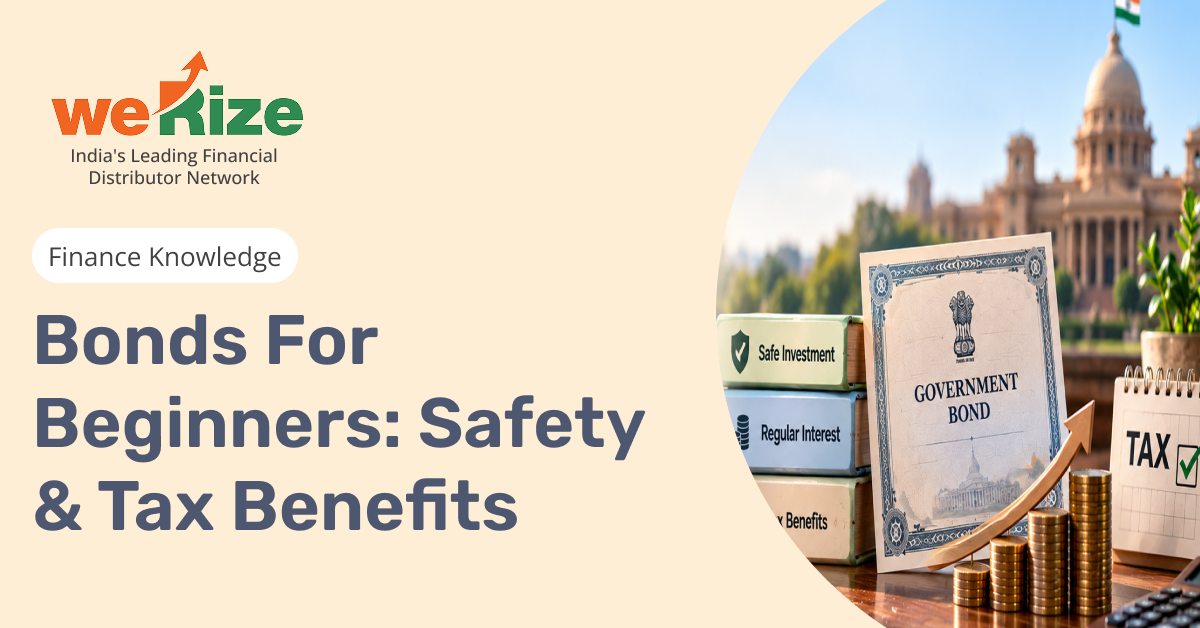
Government bonds are loans you give to the government. Since the government backs them, they carry very low default risk.
The main types are:
- G-Secs: They have long maturities, often from 5 to 40 years.
- Treasury bills: They are short-term.
- SDLs: They come from state governments and often pay slightly more than G-Secs.
- Floating rate savings bonds: Their rate resets from time to time.
Moreover, you can buy government bonds through RBI Retail Direct. Also, the minimum investment is usually small. Thus, even new investors can begin easily.
However, the interest on most government bonds is taxable. So, check the current tax rules before you invest.
Corporate Bonds in India
Companies issue corporate bonds to raise money. For example, a company may want to build a new plant or repay old debt.
Corporate bonds usually pay higher interest than government bonds. Nevertheless, they carry more risk. After all, a company can face losses or fail to pay.
That is why credit ratings matter. Agencies such as CRISIL, ICRA, CARE, and India Ratings rate these bonds. For instance, AAA is the highest safety rating. On the other hand, lower ratings mean higher risk and higher promised returns.
Similarly, you should read the offer document. In particular, look at who issued the bond and whether the bond is secured. A secured bond has assets backing it. Therefore, it is usually safer than an unsecured one.
Bond Returns and How They Are Calculated
Bond returns come from two sources. First, you earn interest. Second, you may gain or lose when the price changes.
Here are the main return measures:
- Coupon rate: This is the fixed interest on face value.
- Current yield: This is the yearly interest divided by the current market price.
- Yield to maturity (YTM): This is the total return if you hold the bond until maturity. It counts the interest and any price gain or loss.
Let us see a simple example.
| Detail | Amount |
| Face value | ₹10,000 |
| Coupon rate | 7% |
| Yearly interest | ₹700 |
| Market price today | ₹9,500 |
| Current yield | 7.37% (700 ÷ 9,500) |
In this case, you pay less than face value. As a result, your current yield is higher than the coupon rate. Moreover, you also gain if you hold the bond to maturity.
Note that these numbers are only examples. Real returns depend on the bond you pick.
Bond Interest Rates: What Investors Should Know
Bond interest rates tell you how much a bond pays. However, they also move with the wider economy.
The RBI sets the repo rate. When the repo rate rises, new bonds often offer higher interest. As a result, older bonds with lower rates become less attractive. Hence, their prices fall.
On the other hand, when rates fall, older bonds with higher rates look better. Consequently, their prices rise.
Besides, inflation plays a role. If inflation is high, investors want higher interest to protect their money. Therefore, always compare the bond rate with inflation. This shows your real return.
Also, check the tax. For example, if your tax slab is high, your post-tax return will be lower.
Factors That Affect Bond Returns
Several things change what you earn from a bond.
- Interest rate changes: Rate hikes lower bond prices. Rate cuts raise them.
- Credit rating: A better rating means lower risk. Similarly, a downgrade can hurt the price.
- Time to maturity: Long-term bonds move more when rates change.
- Inflation: High inflation reduces your real return.
- Liquidity: Some bonds are hard to sell. Consequently, you may have to accept a lower price.
- Taxes: Tax rules can change your final gain.
Moreover, issuer health matters too. For instance, a company with strong profits is more likely to pay on time.
Bond Investment Risks to Consider
Bonds are safer than shares in many cases. Still, they are not risk-free.
- Interest rate risk: Bond prices fall when rates rise.
- Credit risk: The issuer may delay or miss payments.
- Liquidity risk: You may not find a buyer when you want to sell.
- Inflation risk: Your returns may not beat rising prices.
- Reinvestment risk: You may have to reinvest interest at lower rates.
- Call risk: Some issuers can repay early. Thus, you may lose future interest.
Therefore, read every bond’s details before you invest. In addition, never put all your money in one bond.
Government Bonds vs Corporate Bonds
Let us compare the two side by side.
| Feature | Government Bonds | Corporate Bonds |
| Issuer | Central or state government | Companies |
| Safety | Very high | Depends on the rating |
| Interest rate | Usually lower | Usually higher |
| Credit risk | Very low | Low to high |
| Liquidity | Generally good | Varies by bond |
| Best for | Safety-first investors | Investors who want higher income |
Overall, government bonds suit people who want safety. Meanwhile, corporate bonds suit people who accept some risk for extra income. Furthermore, many investors hold both.
How to Choose the Right Bonds for Your Investment Goals
The right bond depends on your needs. So, ask yourself a few questions.
- What is my goal? If you want steady income, pick bonds with regular interest. Similarly, if you want to save for a future date, match the bond’s maturity to that date.
- How much risk can I take? If you dislike risk, choose government bonds or AAA-rated bonds.
- How long can I stay invested? If you might need cash soon, pick short-term or easy-to-sell bonds.
- What is my tax slab? Then, compare post-tax returns.
Besides, check the credit rating and the issuer’s history. In particular, do not choose a bond only for its high rate. A very high rate often signals high risk.
How to Build a Diversified Bond Portfolio
Diversification means spreading your money across different bonds. As a result, one bad event hurts you less.
Here are some simple ways:
- Mix government and corporate bonds. For example, hold 60% in government bonds and 40% in high-rated corporate bonds.
- Spread the maturities. Buy short, medium, and long-term bonds. This is called laddering. Moreover, it gives you cash at different times.
- Use different issuers. Do not depend on one company.
- Consider bond funds. Further, they spread your money across many bonds with small amounts.
The split above is only an example. Your own mix should match your goals and risk comfort. Meanwhile, review your portfolio once or twice a year and adjust it if needed.
Common Mistakes to Avoid When Investing in Bonds
Many new investors repeat the same errors. Therefore, keep these in mind.
- Chasing high returns. As mentioned earlier, high interest often means high risk.
- Ignoring credit ratings. Always check the rating before you buy.
- Putting all money in one bond. Instead, diversify.
- Forgetting about inflation and tax. Otherwise, your real return may be lower than you think.
- Ignoring liquidity. Some bonds are hard to sell early.
- Skipping the fine print. Read the offer document fully.
- Using unregulated platforms. Use only SEBI-registered platforms and the RBI Retail Direct portal.
Conclusion
Bonds can give you steady income and add balance to your portfolio. Furthermore, they are easy to start with once you know the basics.
To recap, you now know how to invest in bonds in India. You know the types, the returns, the interest rate factors, and the risks. In addition, you know how to pick bonds and build a mixed portfolio.
So, start small, check ratings, and stay patient. Finally, remember that every investment has some risk. Read all documents carefully and speak to a SEBI-registered advisor if you are unsure.