English








Bonds have a safe image. Many customers think they are like fixed deposits. However, that is not always true. Bond market risks are real, and they can change the returns a customer earns.
As a financial agent, you play a big role here. Customers trust your words. Therefore, you must explain risks clearly and honestly. Moreover, simple language helps customers feel calm and confident.
In this blog, you will learn the main types of bond risks. Similarly, you will see how to explain each risk in plain words. Finally, you will get tips to reduce risk and avoid common mistakes.
What Are Bond Market Risks?
A bond is a loan. The investor lends money to a company or a government. In return, the issuer pays interest and gives back the money on a set date.
Bond market risks are the chances of losing money or earning less than expected. For example, the issuer may fail to pay. Similarly, bond prices may fall before the customer sells.
Besides that, some risks are small, and some are big. Meanwhile, each bond carries its own mix of risks. That is why every customer needs a clear picture before investing.
Why Should Financial Agents Explain Bond Risks to Customers?
Many customers hear only one thing: “fixed returns.” As a result, they may ignore the risks. Later, a price drop can shock them.
First, clear talk builds trust. Customers feel safe when you share both good and bad points. Moreover, they are more likely to stay with you for the long term.
Second, clear talk avoids complaints. If a customer knows the risks upfront, they will not feel cheated. Further, it keeps your work in line with fair selling rules.
Third, clear talk leads to better choices. A customer who knows the risks can pick a bond that suits them. Therefore, honest advice helps both sides.
Types of Bond Investment Risks
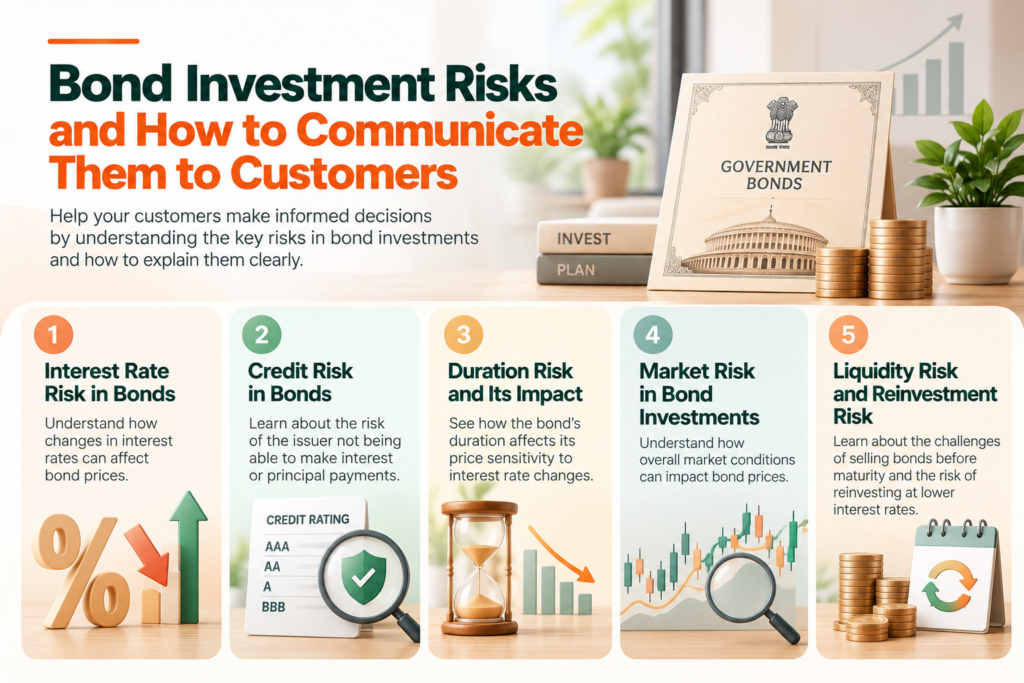
Bonds carry several types of risk. Below is a quick table to help you see them side by side.
| Risk Type | What It Means | Simple Example | How to Explain It |
| Interest rate risk | Bond prices fall when rates rise | Rates go up, and your old bond loses value | “New bonds pay more, so old ones look less attractive.” |
| Credit risk | The issuer may not pay | A weak company delays interest payments | “The borrower may struggle to pay you back.” |
| Duration risk | Long bonds react more to rate changes | A 10-year bond drops more than a 2-year bond | “The longer the bond, the bigger the price swing.” |
| Market risk | Overall market mood moves prices | Bad news lowers bond prices | “Prices can move up or down with market news.” |
| Liquidity risk | You may not find a buyer quickly | You need cash, but nobody buys your bond | “You may not be able to sell fast at a fair price.” |
| Reinvestment risk | Future returns may be lower | Your bond matures, and rates are now lower | “You may earn less when you reinvest your money.” |
Now, let us look at each risk in detail.
Interest Rate Risk in Bonds
Interest rate risk is the most talked-about risk in the bond market. It is also a key part of bond market risks. Simply put, bond prices and interest rates move in opposite directions.
Here is an easy example. A customer buys a bond that pays 7% a year. Later, new bonds start paying 8%. Now, buyers prefer the new bond. As a result, the price of the old bond falls.
On the other hand, if rates fall, old bonds become more valuable. Similarly, the price goes up because the old bond pays more than new ones.
Importantly, this risk matters most when a customer sells before maturity. However, if the customer holds the bond until the end, they usually get the full amount back. Still, the customer may miss out on better rates in the meantime.
Tip for explaining: Use a see-saw. When rates go up, prices go down. Likewise, when rates go down, prices go up.
Credit Risk in Bonds
Credit risk is the chance that the issuer cannot pay. It may skip an interest payment. In the worst case, it may not return the full amount.
Government bonds usually carry lower credit risk. Meanwhile, company bonds carry more, especially from weaker firms. Besides that, higher interest often comes with higher credit risk.
Credit rating agencies give ratings to bonds. A high rating means lower risk. A low rating means higher risk. Therefore, always check the rating before you suggest a bond.
Moreover, a rating can change over time. For instance, a strong company may face trouble later. As a result, its rating can drop, and its bond price can fall too.
Tip for explaining: Say, “You are lending money. So, ask yourself if the borrower can pay you back.”
Duration Risk and Its Impact on Bond Prices
Duration risk sounds hard, but the idea is simple. Duration shows how sensitive a bond is to rate changes. In other words, it tells you how much the price may move.
A bond with a longer duration reacts more. Meanwhile, a bond with a shorter duration reacts less. For example, a bond with a duration of five years may fall about 5% if rates rise by 1%. This is only a rough guide, but it helps customers understand.
Further, duration is not the same as maturity. Maturity is the date the bond ends. Duration is a measure of price sensitivity. Still, the two are linked. Longer bonds usually have higher duration.
That is why duration risk matters. If a customer fears rate hikes, a short-duration bond may suit them better. Similarly, a customer who can wait may accept a long-duration bond.
Tip for explaining: Compare it to a boat. A big boat rocks more in strong waves. Likewise, a long bond swings more when rates change.
Market Risk in Bond Investments
Market risk is the risk from the wider market. News, policy, inflation, and global events can all move bond prices. Moreover, these events are hard to predict.
For example, high inflation can hurt bonds. Prices rise, and fixed interest buys less. As a result, investors may sell bonds, and prices may fall.
Similarly, weak economic news can shake company bonds. Investors may worry about repayment. Therefore, prices may drop even before any real default.
Besides that, market risk affects all bond types in some way. Meanwhile, its effect is stronger on longer bonds and riskier issuers.
Tip for explaining: Say, “Even a good bond can lose value when the market is nervous.”
Liquidity Risk and Reinvestment Risk
Two more risks deserve attention. Although they get less focus, they matter a lot.
Liquidity risk means the customer may not sell quickly. Some bonds trade rarely. As a result, the customer may need to accept a lower price to find a buyer. Moreover, this risk is higher for small or less-known issuers.
Reinvestment risk means future money may earn less. For instance, a bond matures when rates are low. Then, the customer must reinvest at a lower rate. Similarly, if a bond is called early by the issuer, the customer may face the same problem.
In short, these two risks can quietly cut returns. Therefore, mention them early in your talks.
How Bond Risks Affect Returns
Every risk touches returns in some way. First, interest rate risk can lower the selling price. Next, credit risk can reduce or stop payments. Further, liquidity risk can force a sale at a poor price.
Meanwhile, reinvestment risk lowers future income. Besides that, inflation can eat into the real value of returns. As a result, a bond with a 7% yield may feel much smaller when prices rise fast.
Here is the key point. The yield you see is not always the return you get. Therefore, help customers look at the full picture. Also, remind them that returns are not guaranteed.
How to Communicate Bond Risks Clearly to Customers
Clear talk takes practice. Below are simple steps you can follow.
1. Use plain words. Avoid heavy terms. For example, say “the borrower may not pay” instead of “default risk.” Moreover, explain any term you must use.
2. Use simple examples. Numbers and stories help. Similarly, comparisons like a see-saw or a boat make ideas stick.
3. Share the good and the bad. Do not hide risks to close a deal. In fact, honest talk builds a stronger bond with the customer.
4. Use visuals. A small chart or table makes things easier. Further, customers can review it later.
5. Check understanding. Ask, “Does this make sense to you?” Meanwhile, invite questions. As a result, customers feel heard.
6. Put it in writing. Share a summary of the risks after the meeting. Besides that, include the standard disclaimers.
Risk Mitigation Strategies for Bond Investors
Risk mitigation means lowering the chance or the impact of a loss. You cannot remove all bond market risks. However, you can reduce them.
Diversify. Do not put all the money in one bond. Instead, spread it across issuers and sectors. Similarly, mix government and company bonds.
Check credit ratings. Choose bonds with ratings that match the customer’s comfort. Moreover, review ratings from time to time.
Manage duration. If rates may rise, prefer shorter bonds. On the other hand, if rates may fall, longer bonds can help.
Use a bond ladder. Buy bonds that mature at different times. As a result, money comes back in stages. Further, this lowers both interest rate risk and reinvestment risk.
Hold until maturity. If the customer does not need the money early, holding can reduce price swings. Still, credit risk remains.
Keep some cash ready. An emergency fund helps the customer avoid forced sales. Therefore, liquidity risk becomes less of a worry.
How to Match Bond Risk With Customer Investment Goals
Not every bond fits every person. Therefore, start with the customer’s goals.
First, ask about the time frame. A customer who needs money in two years should not pick a very long bond. Similarly, a customer with a ten-year plan can consider longer options.
Next, ask about comfort with ups and downs. Some people lose sleep over small price drops. Meanwhile, others can stay calm. Match the bond to the person.
Further, ask about income needs. For example, a retired customer may want regular interest. In that case, high-rated bonds may suit better.
Finally, review the plan often. Life changes, and so do markets. As a result, the right bond today may not fit next year.
Common Mistakes to Avoid When Explaining Bond Risks
Even skilled agents slip sometimes. Here are the most common mistakes.
- Calling bonds “risk-free.” No bond is fully safe. Moreover, this claim can mislead customers.
- Talking only about returns. High yield sounds great, but it often signals higher risk.
- Using jargon. Hard words confuse people. Therefore, keep it simple.
- Ignoring the customer’s goals. A good bond for one person may be wrong for another.
- Skipping disclaimers. Always share the required risk statements.
- Rushing the talk. Meanwhile, customers need time to think. Slow down and answer questions.
Besides these, avoid promising returns. Similarly, never compare a bond with a fixed deposit without explaining the differences.
Conclusion
Bonds can be a good part of a portfolio. However, they are not free of risk. Interest rate risk, credit risk, duration risk, market risk, liquidity risk, and reinvestment risk can all affect returns.
As mentioned earlier, clear talk builds trust. Moreover, it helps customers choose better. Use simple words, real examples, and honest facts. Further, match each bond to the customer’s goals and comfort level. To become a loan agent & to earn better, join WeRize & start your DSA journey. Start small, stay patient, and grow steadily.
In short, a well-informed customer is a confident customer. Therefore, make risk talk a regular part of every bond conversation.