English


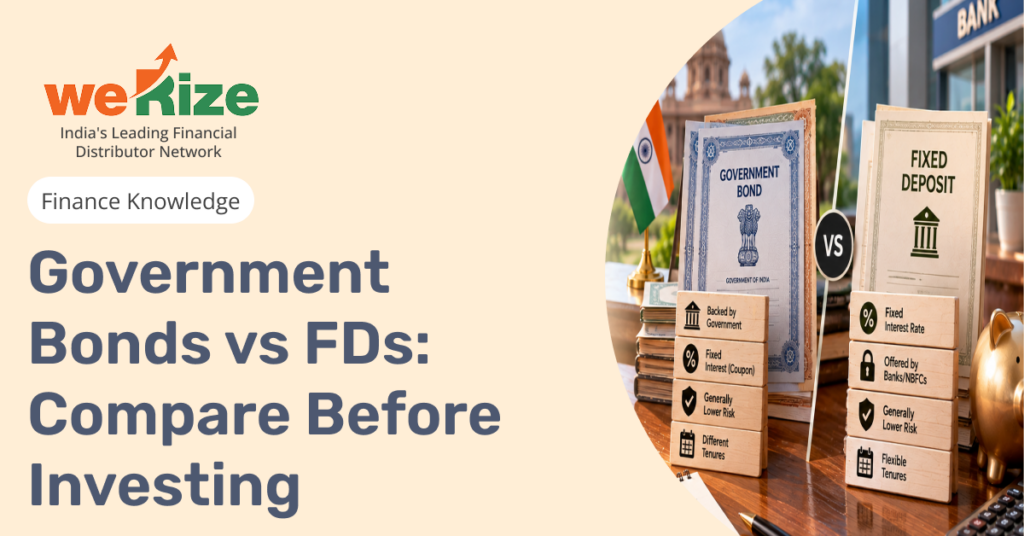




Do you want to grow your savings without losing sleep? Then you have likely heard of two popular choices. These are government bonds and fixed deposits (FDs). Both are simple, and both are known for safety. However, they work in different ways.
Many people pick an FD because it feels familiar. Similarly, some people choose bonds because they trust the government. But which one is really better for you? That depends on your goal, your tax slab, and your need for cash.
In this blog, we compare government bonds v. fixed deposits in plain words. Moreover, we cover bond returns, FD interest rates, safety, tax, and more. By the end, you will know which option fits you best.
What Are Government Bonds and Fixed Deposits?
Let us start with the basics. First, we look at each option on its own. Then, we compare them.
What Is a Government Bond?
A government bond is a loan you give to the government. In return, the government pays you interest at fixed times. At the end of the term, you get your money back. These bonds are also called G-Secs (Government Securities).
The Reserve Bank of India (RBI) manages them for the Centre and the states. Besides that, you can buy them through the RBI Retail Direct platform. Some bonds pay interest twice a year. Others, like treasury bills, are sold at a discount and repaid at full value.
What Is a Fixed Deposit?
A fixed deposit is a deal between you and a bank. You keep a lump sum with the bank for a fixed time. In return, the bank pays you a fixed rate of interest. You can pick a term from 7 days to 10 years.
Banks and some finance companies (NBFCs) offer FDs. Furthermore, you can choose to get interest monthly, quarterly, or at maturity. This makes FDs easy to plan around.
Government Bonds vs Fixed Deposits: Key Differences
Now let us see how the two differ. The table below gives a quick view. As mentioned earlier, each option has its own strengths.
| Feature | Government Bonds | Fixed Deposits |
| Issued by | Central or state government | Banks or NBFCs |
| Safety | Backed by the government | Bank deposits insured up to ₹5 lakh |
| Returns | Fixed coupon; price can change if sold early | Fixed rate for the full term |
| Tenure | Short to very long (up to 40 years) | 7 days to 10 years |
| Liquidity | Can be sold in the market | Early break with a penalty |
| Minimum amount | Around ₹10,000 | Often ₹1,000 or less |
| TDS | Usually not deducted on most G-Secs | 10% if interest crosses the limit |
Note: Rates, limits, and rules change. Please check the latest details before you invest.
As you can see, the two options are alike in some ways. Meanwhile, they differ in tenure, tax, and how easy it is to exit.
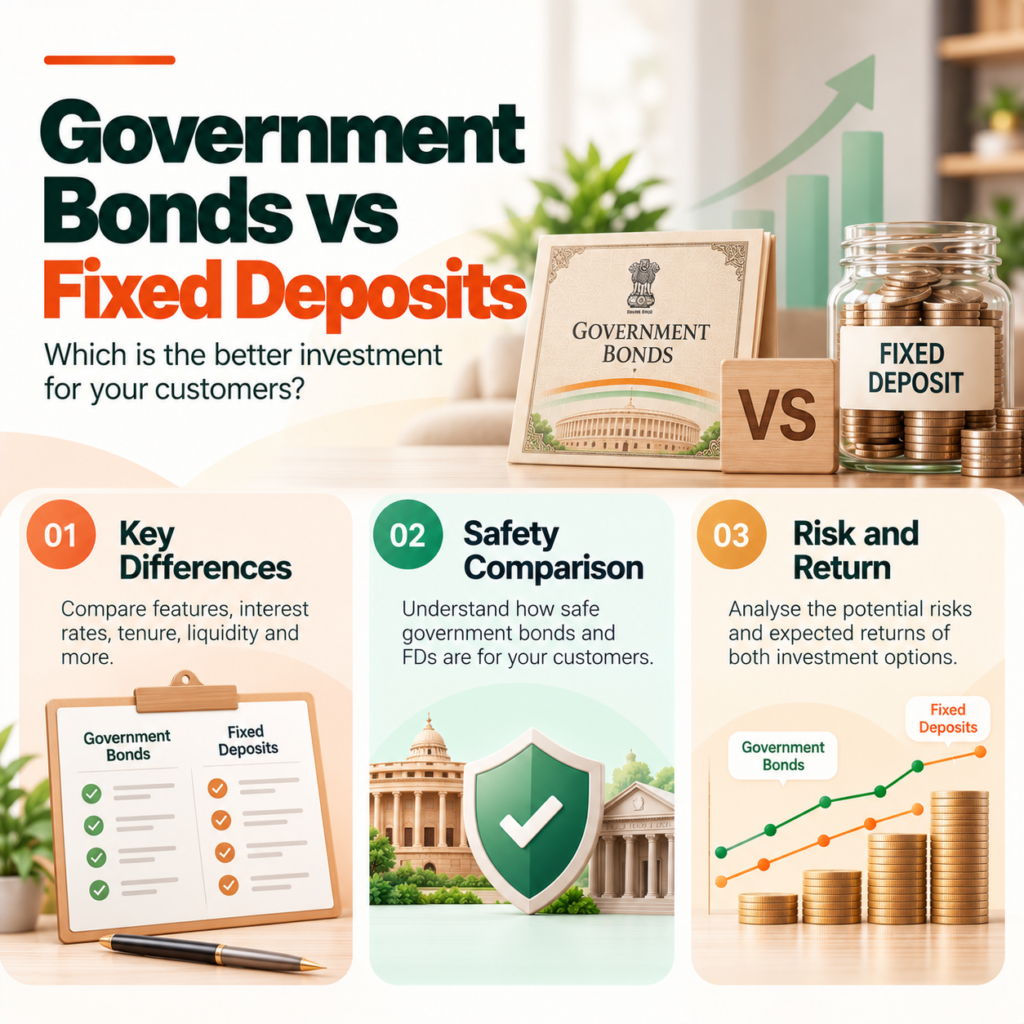
Government Bonds vs Fixed Deposits: Safety Comparison
Safety is the top concern for most investors. So, let us look at it closely.
Government bonds carry very low credit risk. The government pays interest and returns your money on time. Hence, many people treat them as one of the safest choices.
FDs are also safe, but the protection works differently. Bank deposits are insured up to ₹5 lakh per depositor, per bank. This cover includes both your principal and interest. Therefore, if you keep a large sum, you should spread it across banks.
Company FDs from NBFCs carry more risk. They do not have the same insurance. Thus, always check the credit rating before you invest.
In short, both are safe. Nevertheless, government bonds have the edge in safety for very large amounts.
Government Bond Returns vs FD Interest Rates
Returns matter as much as safety. Let us compare bond returns and FD interest rates.
Government bond yields move with the market. They often sit close to the RBI’s rate stance. Historically, yields have been in the range of about 6% to 7.5%. However, this range changes over time.
FD interest rates depend on the bank. Most banks offer a rate in the range of about 6% to 7.5% too. Senior citizens usually get an extra 0.25% to 0.50%. Besides that, small finance banks often pay a bit more than large banks.
Here is one key point. An FD rate stays fixed once you book it. In contrast, a bond’s price can rise or fall in the market. So, if you hold a bond until maturity, you get the promised return. But if you sell early, the return can be different.
Also, do not look only at the headline rate. Look at your return after tax. Later in this blog, we cover this in detail.
Government Bonds vs FDs: Risk and Return Comparison
Every investment has a trade-off. So, let us look at the risk and return side by side.
Government bonds:
- Credit risk is very low.
- Interest rate risk exists. When market rates go up, bond prices usually fall.
- Returns are fixed if you hold until maturity.
Fixed deposits:
- Credit risk is low for bank FDs, and a bit higher for company FDs.
- There is no price swing. Your money grows at the set rate.
- Returns are fixed and easy to predict.
Simply put, FDs are simpler. Similarly, bonds are simple if you hold them till the end. However, bonds ask for a little more understanding if you plan to trade them.
Moreover, neither option beats inflation by a big margin. If prices rise fast, your real gain shrinks. Hence, you may want to mix in other assets for long-term growth.
Government Bonds vs FDs: Tenure and Liquidity
Tenure means how long your money stays locked in. Liquidity means how fast you can get it back.
Government bonds offer a wide range of tenures. You can pick a bond from a few months to up to 40 years. This suits people who want to lock in a rate for a very long time.
FDs offer shorter and more flexible terms. Most people choose one to five years. Further, tax-saving FDs have a five-year lock-in.
Now, let us talk about liquidity. You can sell a government bond in the secondary market. So, you do not have to wait for maturity. However, the price on that day may be higher or lower than what you paid.
With an FD, you can usually break it early. Yet, the bank charges a penalty, often around 0.5% to 1% of the interest rate. Some FDs, such as tax-saving ones, cannot be broken at all.
Meanwhile, if you may need cash soon, keep that part in a short-term FD or a liquid option.
Government Bonds vs FDs: Taxation and TDS
Tax can change your real return. Therefore, pay close attention here.
Tax on FD interest: The interest you earn is added to your income. You pay tax as per your slab. Besides that, the bank deducts TDS at 10% if your interest crosses the yearly limit. The limit is ₹50,000 for most people and ₹1 lakh for senior citizens. If you do not give your PAN, the TDS rate is higher.
Tax on bond interest: Interest from government bonds is also taxed as per your slab. However, most G-Secs do not have TDS. So, you must include the interest in your return and pay tax yourself. Some savings bonds may follow different TDS rules, so check the terms.
Capital gains: If you sell a bond before maturity, you may earn a gain or loss. That gain is taxed under capital gains rules.
Overall, the tax rate on interest is the same for both options. But TDS rules differ. Thus, always plan your taxes, or ask a tax expert.
Government Bonds vs FDs: Investment Amount and Accessibility
How much money do you need to start? And how easy is it to invest?
For FDs, the entry is very easy. You can open one online in a few minutes. Many banks accept small amounts. Moreover, you can also book a recurring deposit for smaller monthly savings.
For government bonds, the minimum is usually around ₹10,000 on the RBI Retail Direct platform. You need to register and complete KYC. Further, the process feels new to many people. Yet, once you set it up, buying more bonds is quick.
Similarly, both options are available on mobile apps. So, you can invest from home. However, FDs are still more familiar and simpler for first-time investors.
Government Bonds vs Fixed Deposits: Which Investment Suits Different Goals?
Let us match each option to a real goal.
- Short-term goals (up to 1 year): An FD or a treasury bill works well. Both are safe and easy to plan.
- Medium-term goals (1 to 5 years): Both work. FDs give simple, fixed returns. Bonds may give a slightly better yield at times.
- Long-term goals (5 years or more): Government bonds can lock in a rate for many years. This helps if you think rates may fall.
- Regular income (for retirees): FDs with monthly payout and senior citizen rates are popular. Similarly, bonds with half-yearly interest can also work.
- Emergency fund: A short-term FD or a sweep-in FD is more suitable. You get quick access to cash.
Hence, no single winner fits everyone. Your goal decides the answer.
Factors to Consider Before Choosing Between Government Bonds and FDs
Before you invest, ask yourself a few simple questions.
- What is my goal? Know why you are investing and for how long.
- How much risk can I take? If you dislike price swings, an FD feels easier.
- Do I need quick cash? If yes, choose short terms or keep some money liquid.
- What is my tax slab? A higher slab means a lower return after tax.
- Where do current rates stand? Compare bond yields and FD interest rates before you decide.
- How much money do I have? Spread large sums across banks and options.
Besides these, check the rules on the day you invest. Rates and limits can change.
Government Bonds vs Fixed Deposits: Pros and Cons
| Government Bonds | Fixed Deposits | |
| Pros | Very high safety; long tenures; can be sold in the market; usually no TDS on most G-Secs | Easy to open; fixed and predictable returns; flexible terms; extra rate for seniors |
| Cons | Price can change if sold early; needs more understanding; higher minimum amount | Early exit penalty; TDS above the limit; insurance limited to ₹5 lakh per bank |
Conclusion
So, which is better: government bonds or fixed deposits? The honest answer is that it depends on you.
Government bonds suit people who want top safety and long-term rate lock-in. In contrast, FDs suit people who want simplicity, flexible terms, and easy access. Moreover, many smart investors use both. This way, they balance safety, returns, and liquidity. To become a loan agent, sell RDs, FD & FD credit cards, & to earn more, join WeRize & start your DSA journey. Start small, stay patient, and grow steadily.
As a next step, write down your goal and your time frame. Then compare current bond returns and FD interest rates. Finally, choose the option that fits your plan.