English








Getting your credit card application rejected is frustrating. It feels even more confusing when you have no credit score to begin with. After all, how can a score that doesn’t exist cause a rejection?
In fact, banks look at many other things besides your score. So, even with zero credit history, your application can still get turned down. This happens more often than most people realize, especially with first-time applicants.
In this blog, we will explain why this happens. We will also share simple credit card approval tips to help you next time. As mentioned earlier, the reasons go beyond just your score. Let’s break it down step by step.
Can a Credit Card Application Be Rejected Without a Credit Score?
Yes, it can. Many first-time applicants assume that no score means no risk. However, banks don’t see it that way.
Without a score, the bank has no proof of how you handle money. Therefore, it looks at other factors instead. These include your income, your job stability, and your banking history.
In other words, a missing score doesn’t protect you from rejection. Instead, it shifts the bank’s focus to different checks. Meanwhile, small errors in your form can also lead to rejection, regardless of your score.
So, the short answer is simple. Yes, credit card rejections without a credit score happen daily. Let’s look at the exact reasons now.
Why Do Credit Card Applications Get Rejected Without a Credit Score?
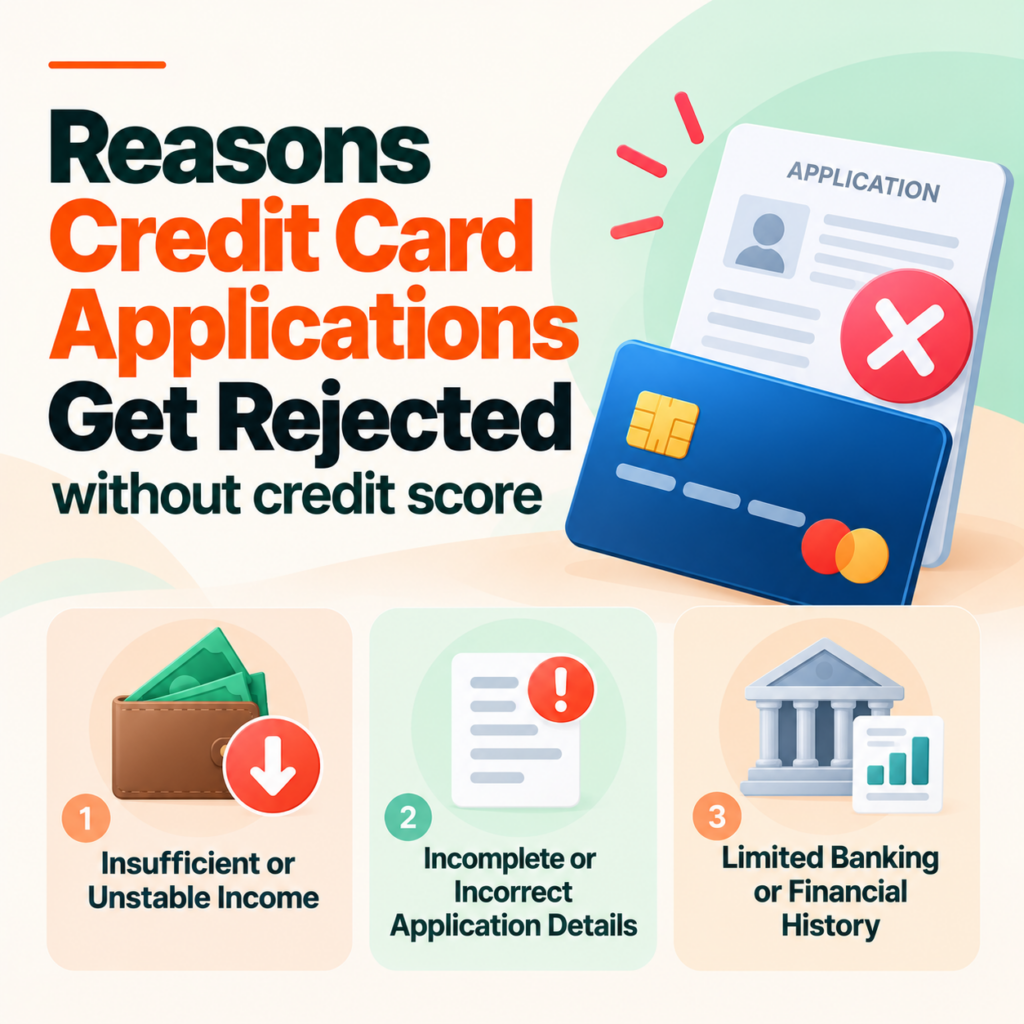
There isn’t just one reason for this. Several factors work together. Below, we explain each one in simple terms.
No Credit History or CIBIL Score
This is the most obvious reason. Banks use your CIBIL score to judge risk. Without it, they have no data to trust.
As a result, some banks reject the application right away. Others may approve it, but with a lower limit. Similarly, some banks may ask for extra documents to feel confident.
This is common among students, homemakers, and young professionals. Besides age, a lack of past loans also causes this gap. So, if this is your first financial product, be prepared for extra scrutiny.
Insufficient or Unstable Income
Income matters a lot, especially without a score. Banks need proof that you can repay the bill each month.
If your income is low, the bank may reject you. Likewise, if your income changes often, this creates doubt. For example, freelancers and gig workers face this issue often.
Moreover, banks usually have a minimum income requirement. If you fall below this line, approval becomes harder. Therefore, always check the income criteria before you apply.
Incomplete or Incorrect Application Details
This reason has nothing to do with your finances. Still, it causes many rejections. A wrong PAN number, misspelled name, or old address can create problems.
In fact, even small mismatches can trigger an automatic rejection. This happens because banks cross-check your details with other databases. Consequently, one small typing error can undo an otherwise strong application.
So, before you submit anything, double-check every field. Also, keep your documents updated and consistent across platforms.
Limited Banking or Financial History
Some applicants have a bank account, but not much activity in it. This is another form of limited history. Without regular transactions, banks cannot judge your habits.
Furthermore, a dormant or rarely used account raises questions. Meanwhile, applicants with a stable and active account often get approved faster. This is because visible transaction patterns act like a mini credit history.
Besides this, banks may also check your savings pattern. A healthy balance, even without a score, can support your case.
Applying for Multiple Credit Cards at Once
This is a common mistake among first-time applicants. Many people apply to multiple banks together, hoping one will approve them.
However, this often backfires. Each application creates an inquiry, even without a score. Banks may see this as desperation or financial stress.
As a result, this habit can lower your chances everywhere. Instead, apply to one bank at a time. Wait for the result before trying another option.
High Existing Financial Obligations
Even without a credit score, banks check your current loans and EMIs. If you already have high monthly payments, this reduces your repayment capacity.
Therefore, banks may see you as a risk, regardless of your score status. Similarly, unpaid bills or pending dues elsewhere also affect this view.
So, it helps to keep your existing obligations low before applying. This makes your income look stronger to the bank.
| Reason for Rejection | Simple Fix |
| No credit history or CIBIL score | Start with a secured or FD-backed card |
| Low or unstable income | Apply with a co-applicant or add income proof |
| Incomplete or wrong details | Double-check every field before submitting |
| Limited banking history | Keep your account active with regular transactions |
| Applying to many banks at once | Apply to one bank at a time |
| High existing financial obligations | Clear small dues before applying |
How to Improve Your Chances of Credit Card Approval
Now that we know the reasons, let’s talk about solutions. These credit card approval tips can help, even without a score.
First, keep your bank account active. Deposit money regularly and avoid letting it sit idle. Second, maintain a steady income source, even if it’s modest.
Additionally, fill out your application carefully. Match every detail with your official documents. Furthermore, avoid applying to several banks in the same week.
Besides this, consider building a small savings habit. A consistent saving pattern shows financial discipline. Likewise, paying utility bills on time can also help your case indirectly.
In short, approval depends on more than just a score. It depends on the overall picture you present.
Credit Card Approval Tips for First-Time Applicants
If this is your first card, keep these points in mind.
- Start small. Apply for a basic or entry-level card first.
- Similarly, avoid applying for a premium card right away.
- Use a stable address and contact number on your form.
- Moreover, add a co-applicant if your income is low.
- Keep your documents ready and updated in advance.
As mentioned earlier, small steps build a strong foundation. Over time, this history will help you unlock better offers.
FD-Backed Credit Cards for Applicants Without a Credit Score
This is one of the best options for beginners. An FD-backed card uses your fixed deposit as security. Therefore, the bank takes on less risk.
Because of this, approval becomes much easier. Even with zero credit history, most banks approve these cards quickly. Meanwhile, your credit limit is usually a percentage of your FD amount.
This option is great for students, homemakers, and new earners. Besides easy approval, it also helps build your credit score over time. In turn, this opens the door to better cards later.
So, if you keep facing rejection, this path is worth trying. It’s simple, safe, and beginner-friendly.
What to Do After a Credit Card Application Is Rejected
Rejection isn’t the end. In fact, it’s a chance to improve.
First, find out the exact reason. Banks usually share this if you ask. Next, fix the issue before you reapply. For example, if income was the problem, wait until it improves.
Meanwhile, avoid applying again immediately. Give it at least three to six months. This gap allows your financial profile to strengthen.
Additionally, consider starting with an FD-backed card during this time. This builds your history while you wait. As a result, your next application will have a stronger chance.
Conclusion
To sum up, a credit card rejection with no credit score situation is more common than people think. It usually happens due to income, documentation, or banking history issues, not the score alone.
However, the good news is that every reason has a fix. Whether it’s fixing your form, building your banking habits, or choosing an FD-backed card, small changes can make a big difference. To get an FD-backed credit card or to sell one, join WeRize.
So, don’t lose hope after one rejection. Instead, use it as feedback. With the right steps, approval is closer than it seems.