English


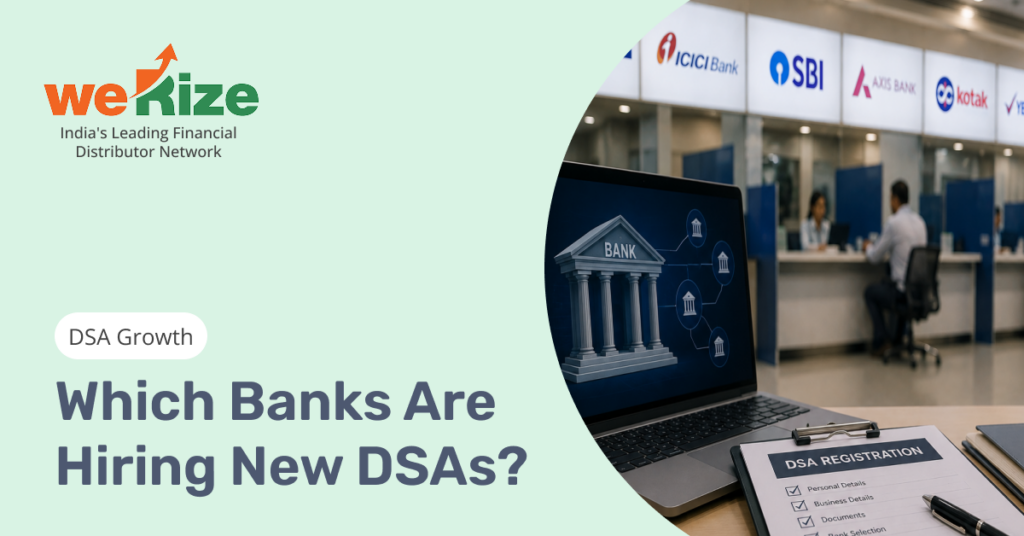






Do you want to earn a steady income by helping people get loans? Then, DSA registration for banks is a good place to start. A bank DSA, or Direct Selling Agent, connects loan seekers with banks. In return, the agent earns a commission on every loan that gets approved.
The demand for DSA partners keeps rising every year. As a result, more banks now welcome new agents through a simple DSA registration online process. Similarly, the digital shift has made it easier than ever to apply, upload documents, and start working from any city.
In this guide, we will explain DSA registration for banks in detail. Moreover, we will share a bank DSA registration list, the eligibility rules, and the documents you need. Besides that, we will cover the step-by-step process and tips to get approved faster. So, let’s begin.
What is DSA Registration for Banks?
DSA registration for banks is the process of becoming an authorised loan partner for a bank. In simple words, once you register, the bank allows you to source loan customers on its behalf. You do not lend money yourself. Instead, you help people apply, and the bank handles the approval and disbursal.
Once a loan gets approved, you earn a commission. This commission is usually a percentage of the loan amount. Therefore, the more loans you source, the higher your income becomes.
Banks offer DSA partnerships for many loan types. For instance, you can source home loans, personal loans, business loans, and car loans. Furthermore, many banks also include credit cards under their DSA programs. This gives you multiple ways to build your income.
Why Become a Bank DSA Partner?
India’s loan market keeps growing every year. Millions of people need funds for homes, business, education, and emergencies. Meanwhile, many of them find it hard to compare banks or complete the paperwork on their own. This is exactly where a bank DSA partner adds value.
Here are some reasons why this career works well right now:
- You can work as a bank DSA partner part-time or full-time.
- You do not need a large investment to start.
- You can operate from your home city or town.
- You can earn commission based on your own effort and consistency.
- You get to build long-term relationships with multiple banks.
In addition, most banks now offer digital dashboards for their DSA partners. For example, you can track your loan applications, payouts, and customer status online. As a result, you save time and manage more customers with less effort. Undoubtedly, this makes bank DSA registration a smart career move in 2026.
Eligibility Criteria for Bank DSA Registration
Before you apply, you should check whether you meet the basic eligibility rules. Most banks follow similar criteria, though small differences may exist between them. The table below shows the general eligibility criteria at a glance.
| Criteria | General Requirement |
| Age | 21 years and above |
| Education | Minimum 10+2 or graduate (preferred) |
| Citizenship | Indian citizen |
| Work Experience | Not always mandatory, but helpful |
| Background | Clean credit history, no criminal record |
| Business Setup | Individual, proprietorship, partnership, or company |
As you can see, the entry barrier stays quite low. Therefore, almost anyone with the right approach can start this business. However, a strong local network and basic sales skills will help you grow faster.
Documents Required for DSA Registration
Once you meet the eligibility criteria, you need to gather your documents. Correct and complete documents will speed up your DSA registration process. Here is the list of documents you usually need:
- PAN card
- Aadhaar card or other address proof
- Passport-size photographs
- Bank account details and a cancelled cheque
- Educational qualification certificate
- Business registration proof (if applying as a firm or company)
- GST certificate (if applicable)
Additionally, some banks may ask for a police verification certificate. Likewise, a few banks may request proof of prior work experience in sales or finance. So, it helps to keep digital copies of every document ready before you start your DSA registration online.
List of Banks Accepting New DSA Partners in 2026
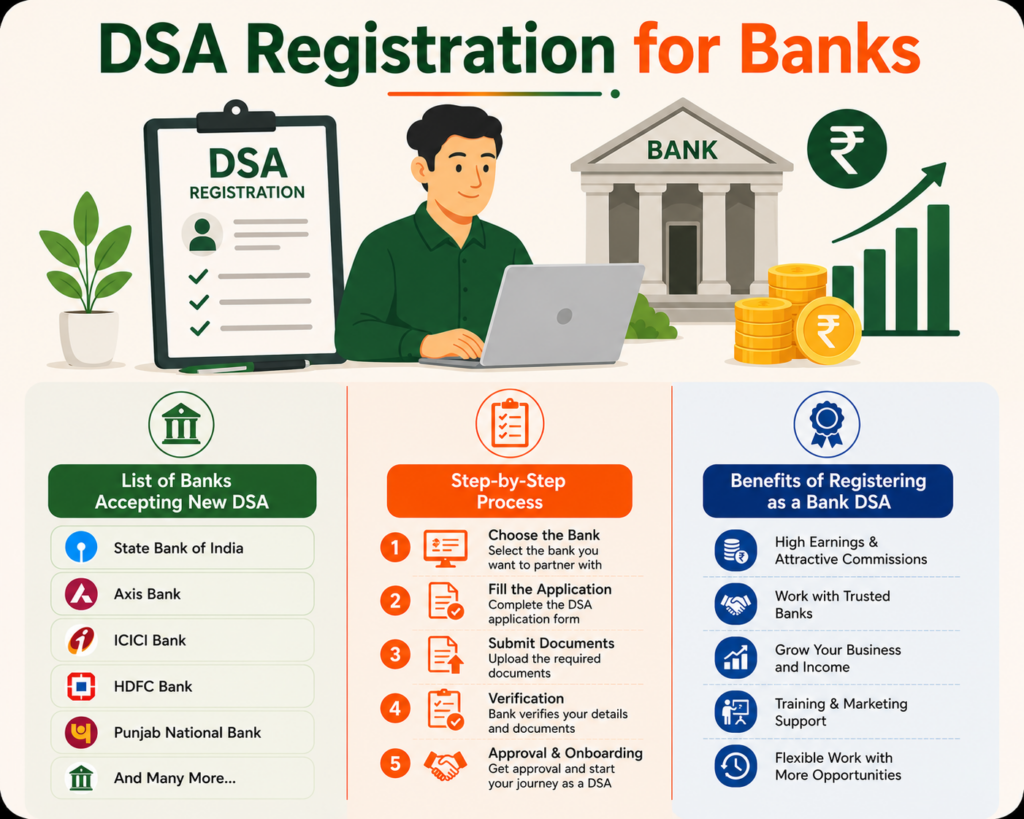
Many banks in India continue to expand their DSA networks in 2026. Here is a general bank DSA registration list to help you get started. Since terms and city-level availability can change, always confirm the latest details directly on each bank’s website before you apply.
Public sector banks:
- State Bank of India (SBI)
- Bank of Baroda (BoB)
- Punjab National Bank (PNB)
- Canara Bank
- Union Bank of India
Private sector banks:
- HDFC Bank
- ICICI Bank
- Axis Bank
- Kotak Mahindra Bank
Small finance banks:
- AU Small Finance Bank
- Equitas Small Finance Bank
Public sector banks generally offer strong trust and lower interest rates. Consequently, many customers prefer them for long-term products like home loans. On the other hand, private and small finance banks often process applications faster and may offer more support for unsecured products like personal loans. Besides banks, several NBFCs and loan distribution platforms also offer DSA partnerships across multiple lenders through a single registration, which can further widen your reach.
Step-by-Step Process for DSA Registration for Banks
Now, let’s look at the step-by-step process for DSA registration for banks.
Step 1: Shortlist Your Preferred Banks
First, shortlist the banks you want to partner with. Compare their loan products, support systems, and reputation. This step matters because every bank works a little differently.
Step 2: Check the Eligibility Criteria
Next, check the eligibility criteria of each bank on your list. As mentioned earlier, most banks ask for a minimum age and basic documents. Make sure you meet these requirements before you apply.
Step 3: Complete the DSA Registration Online Form
After that, visit the bank’s website or partner portal. Fill out the DSA registration online form with your personal and business details. Many banks now offer this process fully online, which saves time.
Step 4: Submit Your Documents
Once you complete the form, upload your documents. Make sure every document stays clear and valid. Otherwise, your application may face delays.
Step 5: Complete Verification
Following this, the bank will verify your documents and background. This process may include a phone call or a physical visit. Meanwhile, stay available to answer any questions from the verification team.
Step 6: Sign the DSA Agreement
After successful verification, the bank will share a DSA agreement. Read this agreement carefully before you sign it. It explains your commission structure, responsibilities, and terms.
Step 7: Start Sourcing Loan Applications
Finally, once you sign the agreement, you can start sourcing loan applications. Use your network, social media, and local contacts to find customers. From here on, your income depends on your effort and consistency.
How to Choose the Right Bank for DSA Registration
No single bank works best for every agent. Instead, the right choice depends on your city, your customer base, and the loan products you want to sell. Here are a few factors to consider.
- Commission structure: Compare payout rates across banks before you decide.
- Processing speed: Some banks approve loans faster than others.
- Product range: Choose banks that offer the loan types your customers need most.
- Support and training: Banks that offer training help new agents grow faster.
- Digital tools: A strong partner portal makes tracking and follow-up much easier.
Similarly, many successful agents choose to register with more than one bank. This way, they can offer more loan options and avoid depending on a single lender. As a result, their income stays more stable, even when one bank slows down approvals.
Benefits of Registering as a Bank DSA
There are many benefits to registering as a bank DSA. Let’s look at the top ones.
- Flexible working hours: You can set your own schedule and work at your own pace.
- Low investment: You do not need a large office or big capital to begin.
- High earning potential: Your income depends on your performance, not a fixed salary.
- Multiple loan products: You can offer several loan types to grow your income streams.
- Trusted brand value: Working with well-known banks builds customer trust faster.
- Work from anywhere: You can run this business from a small town or a big city.
Besides these, many banks now offer digital training and marketing support to their DSA partners. Consequently, new agents can learn faster and start earning sooner.
Tips to Get Your DSA Registration Approved
Here are some practical tips to help your DSA registration for banks get approved faster.
- Keep documents ready: Incomplete documents are the top reason for delays.
- Apply with accurate details: Double-check your form before you submit it.
- Maintain a clean credit history: Banks often check your credit profile during verification.
- Follow up politely: A gentle follow-up call can speed up the verification process.
- Start with well-known banks: Established banks often have clearer, faster onboarding steps.
- Read the agreement carefully: Understand your commission terms before you sign anything.
Above all, stay patient during the approval process. Nevertheless, with accurate documents and a clear application, most agents get approved within a reasonable time.
Conclusion
To sum up, DSA registration for banks opens a flexible and rewarding career path in 2026. It offers low investment, wide product access, and unlimited earning potential based on your effort. However, success depends on choosing the right banks and following the process correctly.
Now that you have a bank DSA registration list and a clear roadmap, you can begin your DSA registration online with confidence. Once again, remember to compare banks, keep your documents ready, and read every agreement carefully. Then, start building your network and offering real value to your customers. With the right approach, you can become a trusted bank DSA partner people rely on.