English










If you are exploring a career in the loan industry, you have likely come across two common terms: DSA and loan agent. At first, both sound the same. However, they are not the same thing. Understanding the difference between a DSA and a loan agent is important before you pick a path. This choice affects your income, your daily work, and your long-term growth.
In this blog, we will break down everything in simple language. We will look at what a DSA does, what a loan agent does, and how their roles differ. Moreover, we will cover eligibility, registration, and earnings for both. By the end, you will know exactly which option suits you best.
What is a DSA?
A DSA, or Direct Selling Agent, is a person or a small business that partners with banks and NBFCs to sell loan products. In other words, a DSA acts as a bridge between the lender and the customer. A DSA finds people who need loans, helps them apply, and earns a commission once the loan gets approved.
DSAs usually work with multiple banks at the same time. Therefore, they can offer customers several loan options to choose from. Besides this, DSAs often build their own small team of agents to bring in more business. As a result, a DSA has more freedom and can scale their income over time.
What is a Loan Agent?
A loan agent, on the other hand, is usually an individual who works to connect borrowers with lenders, often under a DSA or directly with a bank. A loan agent’s job is simpler compared to a DSA. They mainly focus on lead generation and basic paperwork support.
Meanwhile, loan agents may or may not have formal registration with a bank. In many cases, they work under a registered DSA and earn a share of the commission. So, while a loan agent plays an important role, their responsibilities are narrower than those of a DSA.
DSA vs Loan Agent: Key Differences
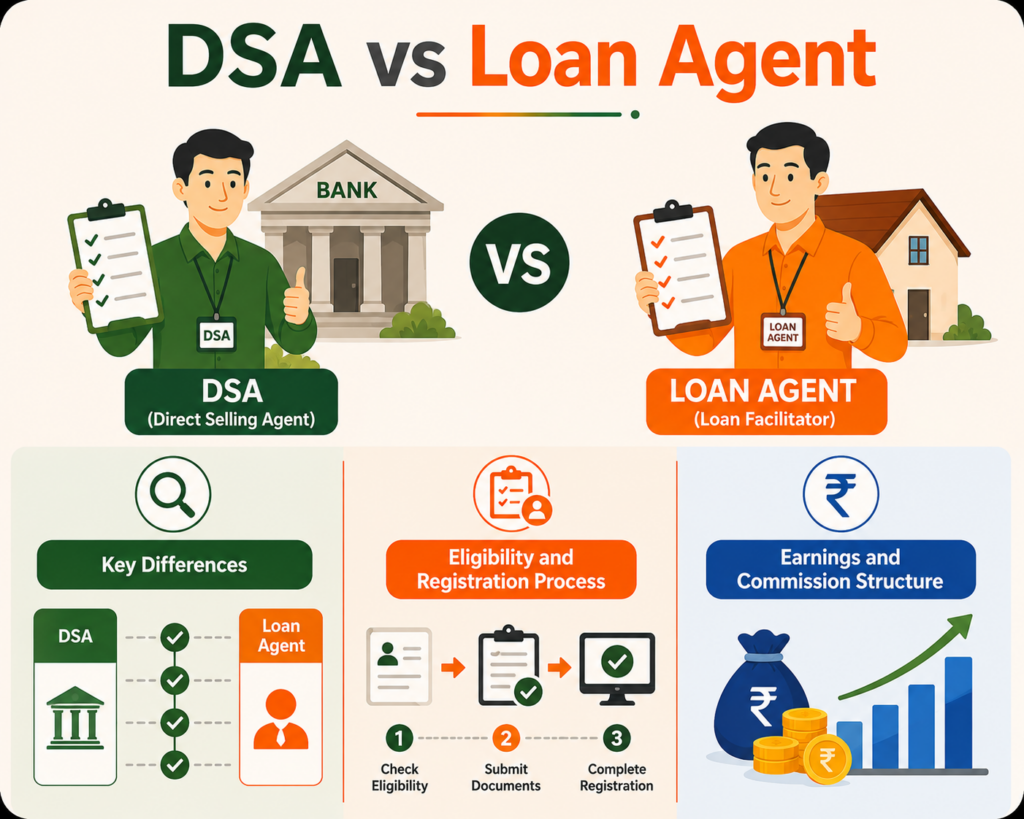
The DSA vs loan agent difference becomes clear once we compare their structure, scale, and independence. A DSA is a registered business entity with direct bank tie-ups. A loan agent, however, is often an individual working under a DSA or a bank’s local network.
Furthermore, a DSA takes on more responsibility, including compliance and documentation. A loan agent usually handles only the initial customer interaction. Similarly, a DSA earns a higher share of commission because they carry more risk and responsibility. A loan agent earns a smaller share since their role is limited.
Below is a simple table to help you understand the DSA vs loan agent difference at a glance.
| Factor | DSA | Loan Agent |
| Meaning | Registered business partner of banks/NBFCs | Individual who sources leads for loans |
| Registration | Direct registration with banks/NBFCs | Usually works under a DSA, may lack direct registration |
| Team Size | Can build and manage a team of agents | Works alone or under a DSA |
| Responsibilities | Sourcing, documentation, compliance, follow-ups | Mainly lead generation and basic support |
| Commission | Higher, since they handle the full process | Lower, since role is limited |
| Independence | High, works with multiple lenders | Limited, often dependent on a DSA |
| Growth Scope | Can grow into a full loan distribution business | Can grow into a DSA over time |
As shown above, the two roles overlap in some ways. However, the level of responsibility and earning potential is quite different.
DSA vs Loan Agent: Roles and Responsibilities
Let’s look closer at what each role actually does daily.
DSA Responsibilities:
- Sourcing loan applications from customers
- Verifying documents before submission
- Coordinating with the bank or NBFC throughout the process
- Following up until the loan is disbursed
- Managing a team of loan agents, if any
Loan Agent Responsibilities:
- Identifying people who need a loan
- Explaining basic loan details to customers
- Collecting initial documents
- Passing the lead to a DSA or bank for further processing
As you can see, a DSA’s work does not end at lead generation. Instead, it continues until the loan is fully disbursed. A loan agent’s job, meanwhile, often ends once the lead is handed over. This is one of the clearest points in the DSA vs loan agent comparison.
DSA vs Loan Agent: Eligibility and Registration Process
Loan agent registration and DSA registration also differ quite a bit. Let’s go through both.
DSA Eligibility and Registration: To become a DSA, you generally need to be above 21 years old. Also, a minimum education of 10+2 or graduation is preferred, though not always mandatory. You must have a valid PAN card, Aadhaar card, and bank account. Besides this, many banks ask for a small registration fee and basic business documents if you are registering as a company.
The registration process usually involves:
- Filling out an application form with the bank or NBFC
- Submitting KYC documents
- Signing a DSA agreement
- Completing a short verification or training session
- Getting your DSA code activated
Loan Agent Eligibility and Registration: Loan agent registration is simpler in comparison. Most lenders or DSAs ask for basic KYC documents like PAN and Aadhaar. Formal education requirements are usually minimal. In many cases, loan agent registration happens directly through a DSA’s onboarding process, rather than through the bank itself.
Therefore, becoming a loan agent is often quicker and requires fewer formalities than becoming a DSA.
DSA vs Loan Agent: Earnings and Commission Structure
Naturally, earnings are a major factor when comparing DSA vs loan agent options.
A DSA earns commission directly from the bank or NBFC. This commission is usually a percentage of the loan amount disbursed. Since a DSA handles the complete process, their commission percentage is higher. Additionally, DSAs who build a team earn extra income from the business their agents bring in.
A loan agent, however, typically earns a smaller cut. This is because they either work under a DSA or receive a fixed referral fee per lead. As mentioned earlier, their role is limited to sourcing and basic support, so their earning potential is naturally lower.
That said, a loan agent can still earn a decent side income, especially if they source a good number of leads regularly. Over time, many successful loan agents choose to register as a DSA to unlock higher earnings.
DSA vs Loan Agent: Which One is Better?
This depends entirely on your goals. If you want full control, higher income, and long-term business growth, becoming a DSA is the better choice. You get to work directly with banks, build a team, and earn more per loan.
On the other hand, if you are just starting or want a low-commitment way to earn extra income, being a loan agent is a good first step. It requires less paperwork and less responsibility. Besides, it lets you understand the loan industry before committing to a full DSA setup.
In short, a loan agent role works well as a starting point. A DSA role works well for those ready to build a proper business. Many people, in fact, start as loan agents and later move up to become DSAs once they gain experience.
How to Become a DSA or Loan Agent in 2026
Here is a simple step-by-step approach for 2026:
- Decide your goal. Ask yourself if you want a side income or a full business.
- Gather your documents. Keep your PAN, Aadhaar, and bank details ready.
- Choose your path. Apply directly to a bank or NBFC for DSA registration, or join under an existing DSA as a loan agent.
- Complete verification. Submit your documents and complete any required training.
- Start sourcing leads. Begin approaching potential borrowers in your network.
- Track your growth. Monitor your commissions and consider upgrading from loan agent to DSA once you gain experience.
Consequently, this path allows you to grow step by step, without taking on too much risk early on.
Common Questions About DSA and Loan Agents
Many beginners ask similar questions before choosing between these two roles. For instance, people often wonder if a loan agent can later become a DSA. The answer is yes, and it is a common career path in this industry.
Others ask whether DSA registration takes a long time. Generally, it takes a few days to a few weeks, depending on the bank’s process. Likewise, many ask if they need an office to become a DSA. In most cases, you can start from home, especially in the beginning.
Conclusion
To sum up, the DSA vs loan agent difference comes down to responsibility, independence, and earnings. A DSA is a registered partner with direct bank ties, higher commissions, and the ability to build a team. A loan agent, meanwhile, plays a smaller, supporting role with simpler entry requirements.
If you are just starting, begin as a loan agent to learn the ropes. Then, once you feel confident, move toward DSA registration to unlock better growth and higher earnings. Either way, this industry offers a solid opportunity for those willing to put in consistent effort.