English


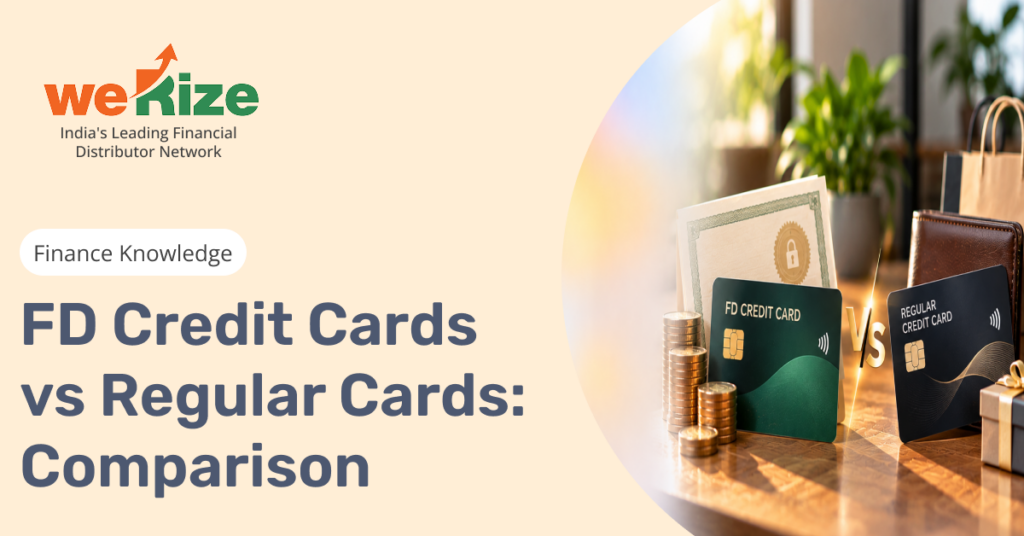



Choosing your first card can feel confusing. Moreover, the choice between an FD-backed credit card and a regular credit card is not always clear. Simply put, one card uses your fixed deposit as security. The other card depends on your income and credit history.
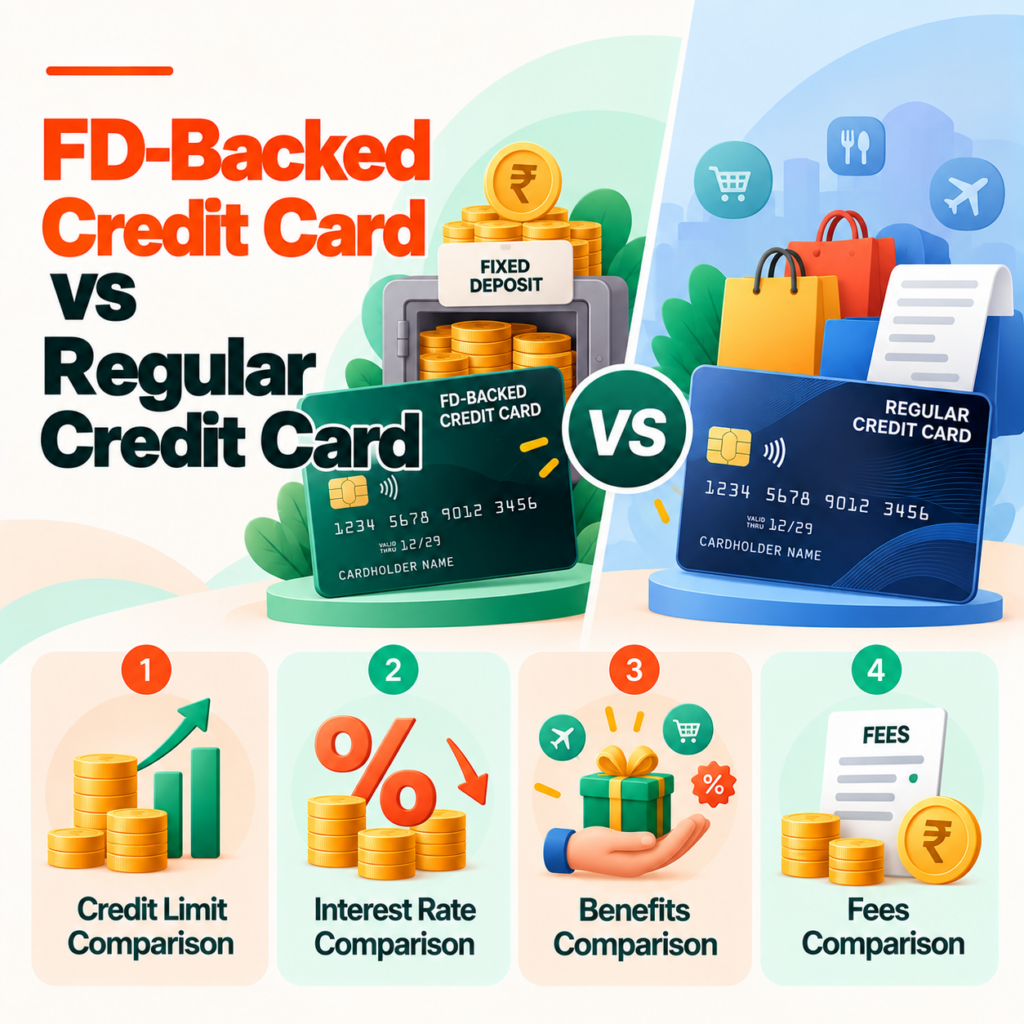
In this guide, we explain the FD-backed credit card vs. regular credit card debate in plain words. Besides that, we compare the credit limit, interest rates, benefits, and fees. Finally, you will know which card fits your needs. So, let us begin.
What Is an FD-Backed Credit Card?
An FD-backed credit card is a secured card. You open a fixed deposit with a bank. Then the bank gives you a card against that deposit. As a result, the bank feels safe because your money acts as security.
Your FD keeps earning interest during this time. Meanwhile, you can use the card for shopping, bills, and online payments. However, the bank places a lien on your FD. This means you cannot break the deposit freely while the card is active.
Additionally, this card is easy to get. Banks do not look closely at your income or credit history. Therefore, many students, beginners, and self-employed people choose it. In short, an FD-backed card gives you a simple way to start.
What Is a Regular Credit Card?
A regular credit card is an unsecured card. You do not need to put down any deposit. Instead, the bank checks your income, job, and credit score. Then it decides your limit.
Similar to an FD-backed card, you can use it for daily spending. Moreover, you get a fixed billing cycle and a due date. You can pay the full bill and avoid interest. Otherwise, the bank charges interest on the unpaid amount.
Further, regular cards come in many types. For example, you can find travel cards, shopping cards, fuel cards, and premium cards. Because of this, regular cards offer more choice. On the other hand, they are harder to get for new users.
FD-Backed Credit Card vs Regular Credit Card: Key Differences
Before we go deep, let us look at a quick view. This table shows the main points side by side.
| Feature | FD-Backed Credit Card | Regular Credit Card |
| Type | Secured | Unsecured |
| Security needed | Yes, a fixed deposit | No |
| Credit limit | Based on FD value | Based on income and score |
| Approval | Easy | Depends on your profile |
| Credit score needed | Usually not strict | Usually a good score needed |
| Rewards | Basic | Wide range |
| Best for | Beginners, low score users | Salaried, good score users |
As mentioned earlier, the biggest difference is security. An FD-backed card needs a deposit. A regular card does not. Therefore, the approval process also differs. Now, let us study each point one by one.
Credit Limit Comparison
The credit limit is the highest amount you can spend on your card. It matters a lot for your monthly needs.
With an FD-backed card, the limit depends on your deposit. Usually, banks give a limit of about 75% to 90% of the FD value. For example, if you deposit ₹50,000, your limit may be near ₹40,000. However, the exact figure differs from bank to bank.
Meanwhile, a regular card follows a different path. The bank checks your income, job type, and credit score. As a result, the limit can be much higher. Besides that, the bank may raise your limit over time if you pay on time.
Similarly, you can ask for a limit increase on both cards. However, an FD-backed card needs a bigger deposit for that. In contrast, a regular card may grow with good habits alone. Overall, a regular card gives more room to grow.
Interest Rate Comparison
Interest is the cost you pay when you do not clear your bill in full. Therefore, it is a key point in this comparison.
Most credit cards charge high interest on unpaid dues. This applies to both types. In many cases, the yearly rate falls in a similar range for both cards. However, some banks charge a slightly lower rate on FD-backed cards because the risk is low.
Moreover, the interest-free period works the same way. You usually get up to 45–50 days if you pay the full bill by the due date. Otherwise, interest starts from the date of purchase. Further, cash withdrawals attract interest right away on both cards.
In addition, remember this simple rule. Interest rates change from bank to bank. Hence, always read the card terms before you apply. In short, paying your full bill on time is the best way to avoid interest on any card.
Benefits Comparison
Benefits make a card worth using. Let us see what each card offers.
FD-backed cards give simple benefits. For example, you may get small cashback, reward points, or fuel savings. Moreover, your FD keeps earning interest. So, you enjoy two gains at once. Besides that, some banks offer lower fees as a bonus.
Regular cards, on the other hand, offer a wider set of benefits. For instance, you may get:
- Reward points on shopping and dining
- Airport lounge access
- Travel and hotel discounts
- Movie ticket offers
- Insurance cover on some cards
Furthermore, premium regular cards give milestone rewards and welcome gifts. However, these cards often require a higher income. Therefore, a new user may not qualify at first.
Meanwhile, FD-backed cards focus on trust and easy access. As a result, they suit people who want to build a base first. Overall, regular cards win on rewards, and FD-backed cards win on ease.
Fees Comparison
Fees can change the real value of a card. Therefore, you should check them with care.
| Fee Type | FD-Backed Credit Card | Regular Credit Card |
| Joining fee | Low or nil | Nil to high, based on card type |
| Annual fee | Low or nil | Low to high, based on card type |
| Late payment fee | Charged by slab | Charged by slab |
| Cash withdrawal fee | Applies | Applies |
| Foreign spend fee | Applies | Applies |
Note: Fees differ across banks. Please check the latest fee list before you apply.
As shown above, FD-backed cards often carry lower joining and annual fees. Moreover, some banks waive them fully. Similarly, some regular cards also waive the annual fee if you spend a set amount.
However, premium regular cards may charge higher fees. In return, they give more perks. Besides that, both cards charge late payment fees, GST, and cash advance fees. Hence, pay on time to avoid these extra costs.
Eligibility and Approval Process
The approval process is where these two cards differ the most.
For an FD-backed card, you usually need:
- An age of 18 years or above
- A valid ID and address proof
- A fixed deposit with the same bank
Moreover, the bank does not ask for strict income proof. Because of this, approval is quick and simple. In many cases, you can get the card within days.
For a regular card, you usually need:
- An age of 21 years or above, in most cases
- Proof of steady income
- A good credit score
- A stable job or business
Further, the bank checks your credit report before it says yes. As a result, some applicants get rejected. Meanwhile, each rejection can leave a mark on your report. Therefore, apply only when you meet the basic rules.
Credit Score Requirements
Your credit score shows how well you handle money. It usually ranges from 300 to 900. A higher score helps you get better cards and loans.
For an FD-backed card, the score is not a big barrier. In fact, people with no score or a low score can still qualify. Moreover, the card helps you build a score from scratch. Every on-time payment gets reported to the credit bureaus. As a result, your score can improve over time.
In contrast, a regular card usually needs a good score. Most banks prefer a score of 750 or above. However, this can vary by card type. Besides that, premium cards ask for even stronger profiles.
Similarly, both cards can help your score if you use them well. For example, keep your usage below 30% of the limit. Also, pay your bill in full each month. Otherwise, your score may fall.
Which Card Is Suitable for First-Time Credit Users?
For most first-time users, an FD-backed card is a safe start. Here is why.
First, approval is easy. You do not need a credit history. Second, your limit stays under control. Therefore, you avoid overspending. Third, the card helps you build a score step by step.
Moreover, the risk is low for you and the bank. Meanwhile, your FD keeps earning interest. As a result, you gain while you learn.
However, a regular card can also suit a first-time user. For example, a salaried person with steady income may get one easily. Likewise, a student with a family member’s support may not. Hence, your own situation matters most.
In short, choose an FD-backed card if you have no credit history. Otherwise, try a regular card if you have a steady income.
How to Choose Between an FD-Backed and Regular Credit Card
Now you know the basics. Next, use these simple steps to decide.
- Check your credit score. If it is low or missing, an FD-backed card is better.
- Look at your income. If you earn steadily, a regular card may work.
- Compare your goals. If you want rewards and travel perks, pick a regular card.
- Review the fees. Read the joining fee, annual fee, and interest rate.
- Think about your deposit. Can you keep money locked in an FD? If not, avoid a secured card.
- Plan your spending. Pick a limit you can repay each month.
Furthermore, you can start with an FD-backed card and switch later. For example, after 6 to 12 months of good payments, many banks offer an upgrade. Similarly, you can apply for a regular card once your score improves. Therefore, the FD-backed card can be a stepping stone.
Conclusion
To sum up, both cards have clear strengths. An FD-backed card offers easy approval, low fees, and a safe start. Meanwhile, a regular card offers higher limits, richer rewards, and more choice.
As mentioned earlier, the best pick depends on your needs. If you are new to credit, start with an FD-backed card. Then build your score with on-time payments. Later, move to a regular card for better benefits.
Above all, use any card with care. Pay your bill in full and on time. Also, keep your spending under control. With smart habits, both cards can help you grow your financial health. To become a loan agent or to sell FD credit cards & to earn more, join WeRize & start your DSA journey. Start small, stay patient, and grow steadily.