English


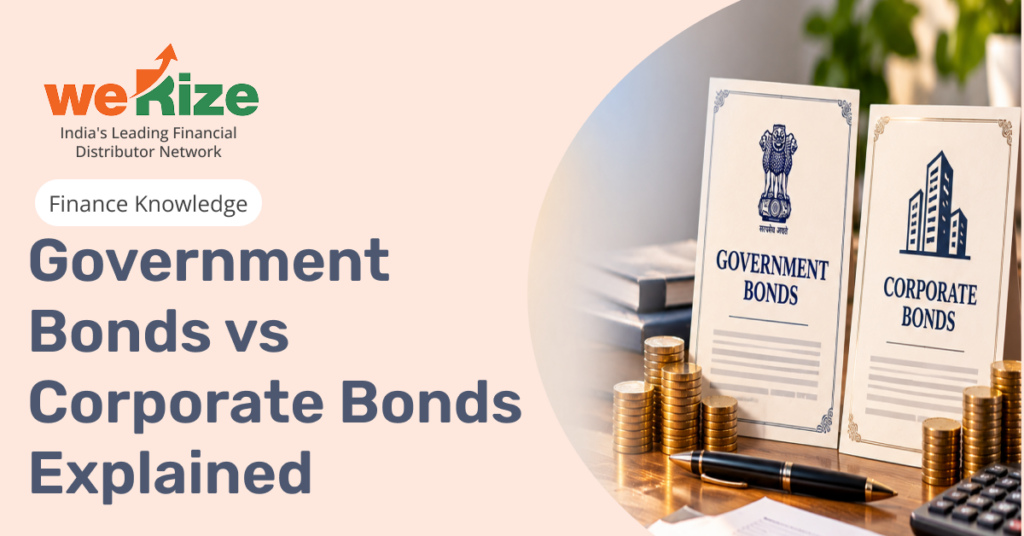





Bonds can feel confusing at first. But they are not hard to understand. In simple words, a bond is a way to lend money and earn interest. Two common types are government securities and corporate bonds.
As a DSA, you must explain both in simple words. Similarly, you must know which bond suits which customer. This guide will help you do that. Moreover, it will give you simple tips to sell bonds better.
What Are Government Securities and Corporate Bonds?
Government securities are bonds issued by the government. Meanwhile, corporate bonds are bonds issued by companies. In both cases, the customer gives money. In return, they get interest.
Government securities are very safe. This is because the government stands behind them. On the other hand, corporate bonds carry more risk. Besides this, corporate bonds usually pay higher interest. This is to make up for the extra risk.
For most customers, both bonds mean one thing. They put in money and get fixed returns. As mentioned earlier, the real difference is who gives the bond and how safe it is.
Government Securities vs Corporate Bonds: Key Differences
Let us look at the key differences in a simple table.
| Feature | Government Securities (G-Sec) | Corporate Bonds |
| Issuer | Government | Private or public companies |
| Risk Level | Very low | Low to high |
| Returns | Lower, but steady | Higher, but can change |
| Liquidity | Easy to buy and sell | Depends on the bond |
| Tenure | Short to very long (up to 40 years) | Usually 1 to 15 years |
| Taxation | Interest is taxable | Interest is taxable |
| Best For | Safe investors | Investors who want more returns |
As you can see, both bonds serve different needs. Therefore, a DSA must first understand what the customer wants.
Types of Bonds in India
A good DSA should also know the common types of bonds in India. This helps you answer customer questions with ease.
- Treasury Bills: Short-term bonds from the government, lasting up to one year.
- Government Bonds: Long-term bonds from the central government.
- State Development Loans: Bonds given by state governments.
- PSU Bonds: Bonds given by government-owned companies.
- Corporate Bonds: Bonds issued by private companies.
- Convertible Bonds: Bonds that can turn into company shares later.
- Tax-Free Bonds: Bonds where you do not pay tax on the interest.
Each bond type has its own use. Similarly, each one fits a different kind of customer. Knowing these types will help you sound more confident.
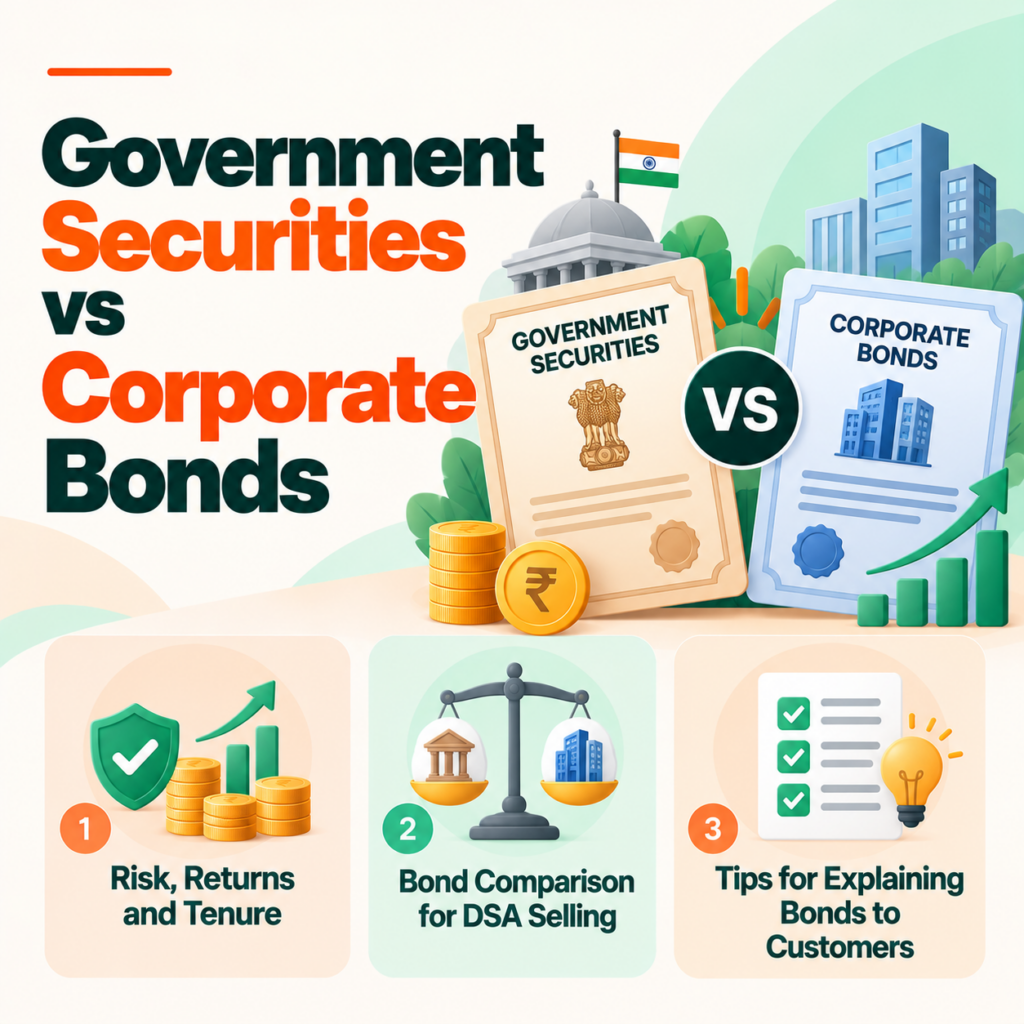
G-Sec vs Corporate Bonds: Risk, Returns and Tenure
Risk, returns, and tenure matter most to customers. Let us look at each one, one by one.
Risk: Government securities have almost no risk. In contrast, corporate bonds depend on how strong the company is. A weak company may fail to pay back its debt. As a result, rating agencies like CRISIL and ICRA grade corporate bonds. This shows how safe or risky they are.
Returns: G-Sec returns are lower. However, they stay steady over time. Corporate bonds, meanwhile, offer higher returns. This is because the customer takes more risk.
Tenure: Government securities come in many time periods. Some last a few months. Others last many years. Corporate bonds, on the other hand, are usually shorter. Most last between one and fifteen years.
In short, the right bond depends on how much risk the customer can take. Additionally, it depends on how long they want to stay invested.
Government Securities vs Corporate Bonds: How Do They Work?
Both bonds work in a simple way. The customer buys the bond. This means they lend money to the issuer. In return, the issuer pays interest at fixed times. Finally, the issuer pays back the full amount at the end.
The Reserve Bank of India sells government securities. Customers can buy them directly or through mutual funds. Corporate bonds, meanwhile, are sold by companies. Customers can also buy them through the stock market.
Once again, the process looks similar for the customer. They put in money and expect returns. However, the risk is not the same. This is the part a DSA must explain clearly.
Bond Comparison for DSA Selling
When you compare bonds for DSA selling, focus on the customer’s needs first. Do not just focus on the product. For instance, a retired customer wants safety. Therefore, government securities suit them better.
On the other hand, a young working customer may want higher growth. Corporate bonds may suit them more. Besides this, always share the credit rating of a corporate bond. This builds trust.
Furthermore, compare the tenure based on the customer’s goals. Someone with a short-term goal may want a shorter bond. Someone planning for old age may want a longer one.
Which Customers May Consider Government Securities?
Government securities usually suit customers who want safety first. These may include:
- Retired people who want steady income
- Careful investors who do not like risk
- Customers building an emergency fund
- Investors who want safe, long-term returns
- First-time bond buyers
Since G-Sec is very safe, it also works well for new investors. In fact, many DSAs use G-Sec to introduce customers to bonds for the first time.
Which Customers May Consider Corporate Bonds?
Corporate bonds may suit customers who can take some risk. These may include:
- Working people who want higher returns
- Investors with a medium-term goal
- Customers who already understand credit ratings
- Business owners who want to spread their money
- Investors who want more than a fixed deposit gives
Notably, a DSA should always check how much risk the customer can handle. This step protects both the customer and the DSA.
How DSAs Can Sell Government Securities and Corporate Bonds
Selling bonds well needs trust and clear talk. Here are some simple steps.
First, understand what the customer wants. Ask simple questions about their income and savings. Second, explain both bonds in plain words. Avoid hard financial terms.
Third, use real examples to show returns. For example, show how ₹1 lakh grows in five years for each bond. Fourth, always share the risk honestly. This builds trust over time.
Finally, follow up after the sale. This shows the customer that you care, not just about the commission.
How DSA Commission Works for Bond Sales
DSA commission on bonds depends on the issuer and bond type. It changes between government securities and corporate bonds. Corporate bonds often pay more commission. This is because they need more effort and carry more risk.
Government securities may pay less commission. However, they are easier to sell since they are safe. As a result, many DSAs use G-Sec first to build trust. Later, they offer corporate bonds to earn more.
Always check the latest commission rules with your platform. Commission can change based on tenure, issuer, and bond type.
Tips for Explaining Bonds to Customers
You do not need hard words to explain bonds. Here are some easy tips.
- Use simple, everyday words
- Compare bonds to something known, like a fixed deposit
- Always share the risk along with the returns
- Use real numbers to show possible earnings
- Keep your explanation short and clear
Above all, stay patient. Many customers are new to bonds. Therefore, giving them time helps build a better relationship.
Common Mistakes to Avoid When Selling Bonds
Even skilled DSAs make mistakes while selling bonds. Avoiding these can build more trust.
- Ignoring risk level: Never sell corporate bonds to a safe-first customer without explaining the risk.
- Promising too much: Do not promise fixed high returns, especially for corporate bonds.
- Skipping credit ratings: Always share the rating of a corporate bond before selling it.
- Using hard words: This confuses customers and breaks trust.
- Hiding lock-in details: Customers must know when they can take out their money.
Avoiding these mistakes helps DSAs build stronger, long-term customers.
Conclusion
There is no single winner in government securities vs corporate bonds. It depends on what the customer wants, how much risk they can take, and how long they wish to invest. Government securities suit safe, steady customers. Corporate bonds, meanwhile, suit those who want higher returns. To become a loan agent or to sell Bonds, & to earn more, join WeRize & start your DSA journey. Start small, stay patient, and grow steadily.
As a DSA, your job is to make this simple. Furthermore, your job is to match the right bond to the right customer. With the tips in this guide, you can explain both bonds with ease and sell them with confidence.