English


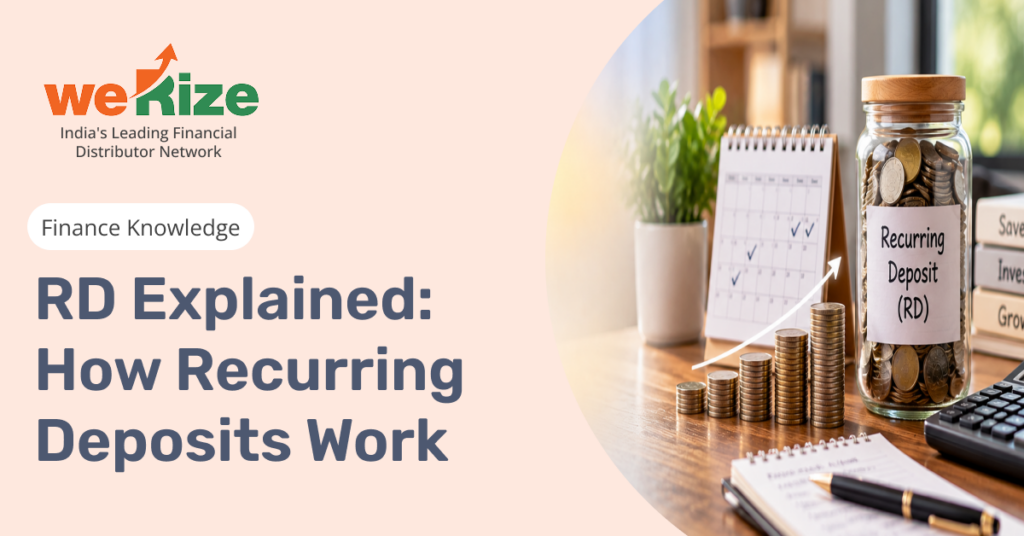



Do you want to save money every month without much effort? A Recurring Deposit, or RD, can help you build this habit. In this guide, we will explain what a recurring deposit is, how RD works, and why it can be a smart choice for beginners. Moreover, we will compare RD with FD, explain RD interest rates, and show you common mistakes to avoid. By the end, you will understand this simple savings tool completely.
What Is a Recurring Deposit?
A Recurring Deposit is a savings scheme offered by banks and post offices. In simple words, you deposit a fixed amount every month for a set period. In return, the bank pays you interest on your money. Furthermore, this interest is usually higher than a regular savings account.
So, what is a recurring deposit used for? People use it to save for goals like a wedding, a vacation, or an emergency fund. Similarly, many beginners use RD as their first step into disciplined saving. Unlike a Fixed Deposit, where you invest a lump sum at once, an RD lets you invest small amounts regularly. As a result, it suits people who earn a monthly salary.
Besides being simple, an RD is also safe. Banks and post offices back it, so your money faces very low risk. Therefore, this RD guide will help you understand every part of the process, step by step.
How Does an RD Work?
Understanding how RD works is not hard. First, you choose a bank or post office. Next, you pick a monthly amount and a tenure, which is the total time period of the deposit. After that, you deposit the same amount every month until the tenure ends.
Meanwhile, the bank calculates interest on each deposit separately, because each deposit stays in the account for a different length of time. As a result, the interest calculation can seem tricky at first. However, most banks use a simple formula, and we will explain it later in this guide.
At the end of the tenure, you receive the maturity amount. This amount includes all your deposits plus the interest earned. In other words, your monthly savings grow steadily into a bigger amount. Additionally, missing a payment usually leads to a small penalty, so it helps to stay consistent.
How to Open a Recurring Deposit Account
Opening an RD account is a quick process. Here is a simple step-by-step approach:
- Choose a bank or post office that offers good RD interest rates.
- Compare the tenure options, since some banks offer flexible periods.
- Decide your monthly deposit amount based on your budget.
- Submit basic KYC documents, such as an ID proof and address proof.
- Set up auto-debit from your savings account, so you never miss a payment.
Nowadays, most banks also allow you to open an RD account online through their mobile app. Therefore, you do not need to visit a branch physically. Once you submit the details, the account usually gets activated within a day.
RD Investment: How Much Can You Invest?
An RD investment is flexible, which makes it beginner-friendly. Most banks allow you to start with an amount as low as ₹100 per month. On the other hand, there is usually no fixed upper limit, although some banks may set one for specific schemes.
Consequently, an RD suits both small savers and those who want to invest larger sums. For instance, a student might start with ₹500 per month, while a working professional might invest ₹5,000 per month. Either way, the process stays the same.
Before you decide your RD investment amount, consider your monthly budget carefully. As mentioned earlier, missing payments can attract penalties. Hence, choose an amount you can comfortably pay every month without financial stress.
RD Interest Rates: How Are They Calculated?
RD interest rates usually depend on the bank and the tenure you choose. Generally, longer tenures offer slightly higher rates. Additionally, senior citizens often receive an extra interest rate benefit, similarly to fixed deposits.
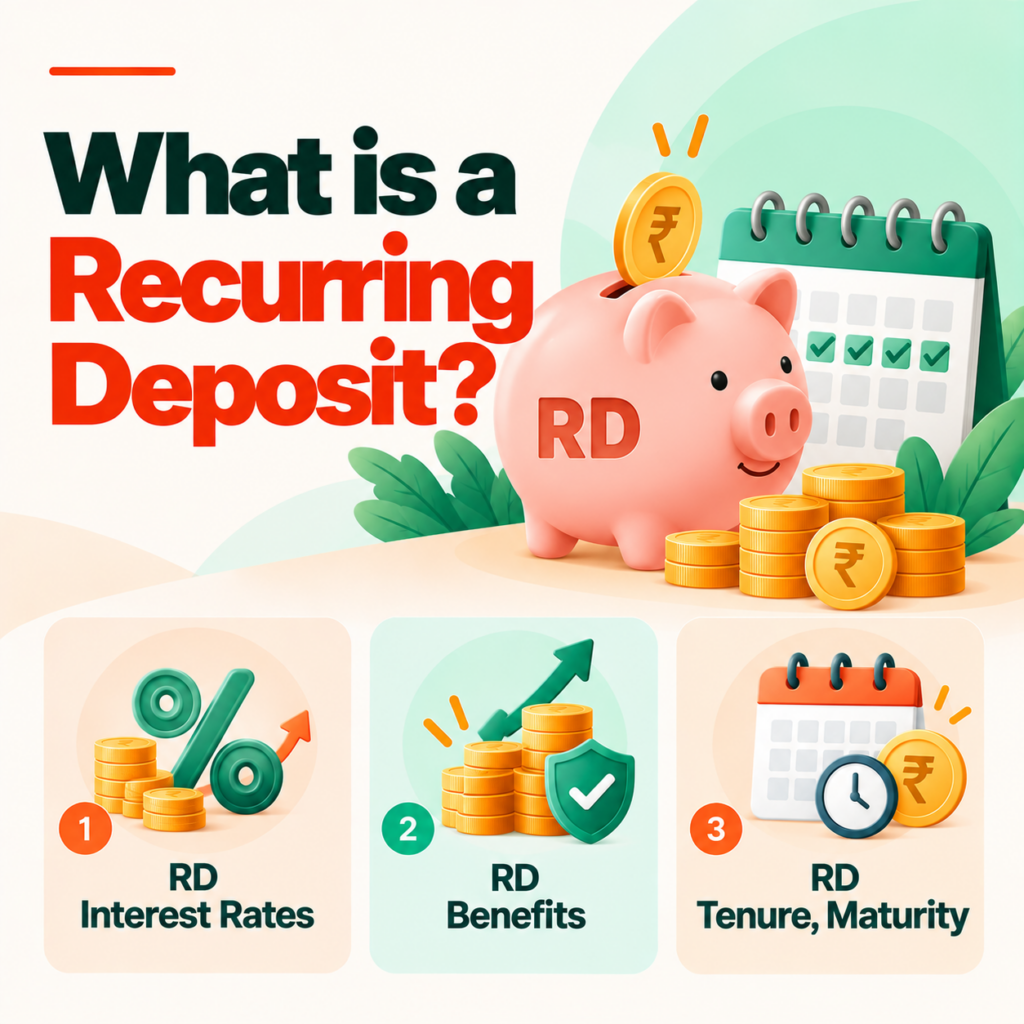
Banks calculate RD interest using the compound interest method, and most banks compound it every quarter. In simple terms, this means the interest gets added to your principal amount every three months. As a result, you earn interest on interest, which slowly increases your total returns.
Here is a simple table showing how the RD interest rate can affect your returns for a monthly deposit of ₹2,000 over one year:
| Interest Rate | Monthly Deposit | Tenure | Approximate Maturity Amount |
| 6.0% | ₹2,000 | 12 months | ₹24,780 |
| 6.5% | ₹2,000 | 12 months | ₹24,845 |
| 7.0% | ₹2,000 | 12 months | ₹24,910 |
| 7.5% | ₹2,000 | 12 months | ₹24,975 |
As shown above, even a small change in the interest rate can slightly change your final maturity amount. Therefore, it always helps to compare rates before choosing a bank.
RD Benefits for Beginners
There are many RD benefits that make it a great choice for beginners. Let us look at them one by one.
First, an RD builds financial discipline. Since you must deposit a fixed amount every month, you naturally develop a saving habit. Similarly, it teaches you to plan your monthly budget better.
Second, an RD offers safety. Banks and post offices are well-regulated, so your money remains secure. Besides, most RDs also come under deposit insurance, up to a certain limit, which adds another layer of protection.
Third, an RD offers predictable returns. Unlike the stock market, where returns can go up or down, an RD gives you a fixed and guaranteed interest rate. Consequently, you know exactly how much you will receive at maturity.
Fourth, RD investment options remain flexible in terms of tenure and amount. Whether you want to save for six months or five years, you can usually find a suitable RD plan. Furthermore, you can open multiple RDs for different goals at the same time.
Lastly, RDs are simple to understand and manage. You do not need any special financial knowledge to start one. As a result, this makes RD a beginner-friendly investment tool.
Recurring Deposit vs Fixed Deposit
Many beginners often compare Recurring Deposit and Fixed Deposit, since both are offered by the same banks. However, the two products work differently.
| Feature | Recurring Deposit (RD) | Fixed Deposit (FD) |
| Investment Type | Monthly deposits | One-time lump sum |
| Best For | Regular monthly savers | People with a lump sum ready |
| Interest Calculation | Compounded quarterly | Compounded quarterly |
| Flexibility | Fixed monthly commitment | Single upfront commitment |
| Ideal Goal | Building a saving habit | Growing existing savings |
As shown in the table, an RD suits people who want to save gradually. Meanwhile, an FD suits people who already have a lump sum and want it to grow. Therefore, your choice depends on your current financial situation.
Who Should Consider an RD?
An RD works well for several types of people. For example, salaried employees who receive a fixed monthly income often find RD useful. Similarly, students who receive monthly pocket money can also use RD to build early savings habits.
Besides, homemakers who manage household budgets often use RD to save for family goals. Furthermore, small business owners with steady monthly income can also benefit from this disciplined approach.
On the other hand, if you already have a large lump sum lying idle, a Fixed Deposit might suit you better. Nonetheless, many people use both RD and FD together to balance their financial goals.
RD Tenure, Maturity and Premature Withdrawal
RD tenure usually ranges from six months to ten years, depending on the bank. Generally, you should choose a tenure that matches your financial goal. For instance, a short-term goal like a vacation might need a one-year RD, while a long-term goal like a car purchase might need a three-year RD.
At maturity, the bank pays you the total deposited amount along with the accumulated interest. Meanwhile, if you need funds urgently, most banks allow premature withdrawal, though this usually comes with a small penalty on the interest rate.
Therefore, it helps to choose your tenure carefully from the start. As mentioned earlier, breaking an RD early reduces your overall returns, so plan your tenure based on realistic timelines.
Taxation on Recurring Deposit Interest
RD interest is taxable under Indian tax laws, similar to Fixed Deposit interest. Banks deduct TDS, or Tax Deducted at Source, once your interest earnings cross a certain limit in a financial year.
However, if your total income falls below the taxable limit, you can submit Form 15G or 15H to avoid TDS deduction. Consequently, it always helps to declare your RD interest income while filing your taxes, since it counts as income from other sources.
Besides, keeping track of your RD interest across different banks becomes important, especially if you hold multiple RD accounts. Therefore, maintaining a simple record can save you from tax-related confusion later.
Factors to Consider Before Starting an RD
Before you start an RD, consider a few important factors. First, compare RD interest rates across different banks, since even a small difference can affect your final returns.
Second, check the tenure options available, and choose one that matches your financial goal. Similarly, consider the monthly amount you can realistically afford without straining your budget.
Third, look at the penalty charges for missed payments or premature withdrawal, since these charges vary between banks. Additionally, check if the bank offers any extra benefits, such as higher rates for senior citizens.
Finally, consider the bank’s reliability and customer service. Nonetheless, most well-known banks and post offices offer trustworthy RD schemes, so this factor rarely becomes a major concern.
Common Mistakes to Avoid With an RD
Even a simple product like RD can go wrong if you are not careful. Here are some common mistakes beginners often make.
First, many people choose a monthly amount that is too high, without considering their monthly expenses. As a result, they struggle to continue payments and face penalties.
Second, some beginners ignore the interest rate comparison between banks. However, comparing rates takes only a few minutes and can improve your returns.
Third, people sometimes forget the tenure they selected, and then withdraw the RD early. Consequently, they lose part of their expected interest.
Fourth, some individuals open multiple RDs without tracking them properly. Therefore, keeping a simple list of your RD accounts, amounts, and maturity dates helps avoid confusion.
Lastly, many people forget about taxation on RD interest, which can lead to issues during tax filing. Hence, it always helps to stay informed about the tax rules mentioned earlier in this guide.
Conclusion
To sum up, a Recurring Deposit is a simple, safe, and beginner-friendly way to build a saving habit. Throughout this RD guide, we explained what a recurring deposit is, how RD works, and how RD interest rates get calculated. Moreover, we compared RD with FD and highlighted the RD benefits that make it useful for beginners. To sell RD, and earn good commission out of it, join WeRize.
Whether you are a student, a salaried employee, or a homemaker, an RD can help you save steadily every month. Therefore, if you are looking for a low-risk way to start your savings journey, a Recurring Deposit is definitely worth considering.