English








Many people want to earn money by helping others get loans. Two common paths exist for this: becoming a loan channel partner or becoming a DSA. However, most people mix up these two terms. As a result, they pick the wrong path for their goals.
In this blog, we will explain the loan channel partner vs. DSA debate in simple words. Moreover, we will cover their roles, earnings, and eligibility. By the end, you will know exactly which model fits you best. Let’s begin.
What Is a Loan Channel Partner?
A loan channel partner works with a bank or a lending company. This partner brings in customers who need loans. In return, the partner earns a commission on every loan that gets approved.
Furthermore, a channel partner usually works at a larger scale. For instance, they may run their own office or team. Besides this, they often deal with bigger loan categories, such as home loans or business loans. In addition, some channel partners also help with loan processing and paperwork.
Notably, a channel partner signs a formal agreement with the lender. This agreement lists the rules, targets, and commission structure. Therefore, the relationship is more structured compared to other models.
What Is a DSA?
DSA stands for Direct Selling Agent. A DSA is a person or a small firm that connects borrowers with banks or NBFCs.Similar to a channel partner, a DSA earns a commission for every loan they bring in.
However, a DSA usually works at a smaller scale. For example, many DSAs work alone or with a small team. Meanwhile, their main job is to find leads and pass them to the lender. The lender’s team then handles the loan processing.
In short, a DSA acts as a bridge between the customer and the bank. Also, becoming a DSA is often easier and faster than becoming a channel partner. This makes it a popular starting point for many people.
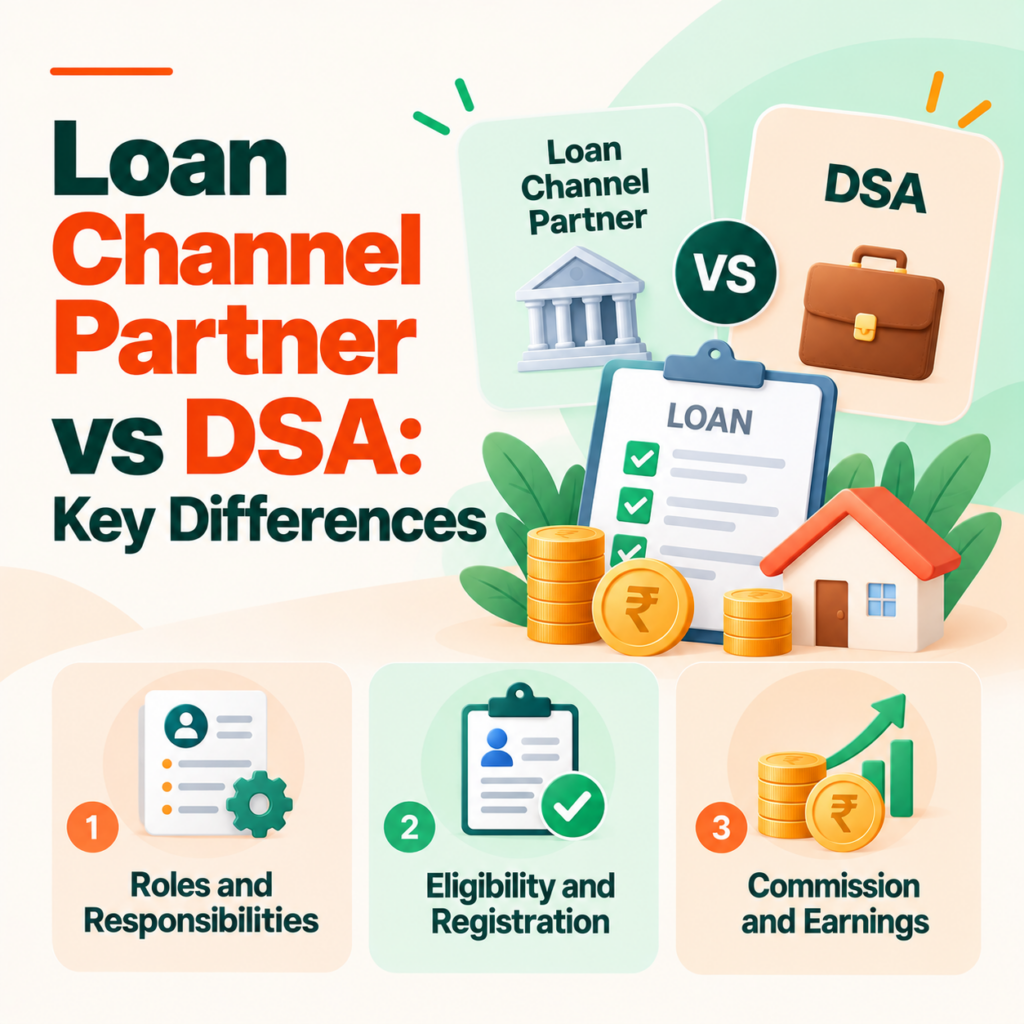
Loan Channel Partner vs DSA: Key Differences
At this point, you may still wonder about the core loan channel partner vs DSA differences. The table below makes this clear.
| Aspect | Loan Channel Partner | DSA |
| Scale of operation | Large, often with a team or office | Small, often solo or a few members |
| Role | Sourcing, processing, and support | Mainly sourcing and lead generation |
| Agreement type | Formal, detailed contract | Simpler registration process |
| Investment needed | Higher | Lower |
| Loan categories | Wide range, including big-ticket loans | Mostly retail loans |
| Commission | Generally higher | Moderate |
| Best for | Established businesses or agencies | Individuals and freelancers |
As shown above, the DSA vs channel partner comparison comes down to scale, investment, and responsibility. Consequently, your choice should depend on your resources and goals.
Loan Channel Partner vs DSA: Roles and Responsibilities
Let’s look closer at what each role actually involves.
Loan Channel Partner Responsibilities:
- Sourcing customers for various loan products
- Verifying basic documents before submission
- Coordinating with the bank’s internal team
- Managing a small team of agents, in many cases
- Meeting monthly or quarterly targets
DSA Responsibilities:
- Finding potential borrowers
- Explaining loan products to customers
- Collecting basic documents
- Forwarding the file to the lender
- Following up until the loan gets approved
As you can see, a channel partner takes on more operational work. On the other hand, a DSA focuses mainly on sourcing and follow-up. Thus, the workload and responsibility differ quite a bit between the two.
Loan Channel Partner vs DSA: Eligibility and Registration
Eligibility rules also separate these two models. Generally, becoming a DSA is simpler. Most lenders ask for basic documents, such as ID proof, address proof, and PAN card. Additionally, some lenders may ask for a small registration fee.
On the other hand, becoming a loan channel partner needs more effort. Usually, lenders prefer partners who already run a business or an agency. Besides this, channel partners may need to show proof of office space, experience, or a minimum team size. Furthermore, the lender may conduct a background check before approval.
In other words, the entry barrier for a DSA is low. Meanwhile, the entry barrier for a channel partner is higher. That said, both paths remain open to anyone willing to meet the requirements.
Loan Channel Partner vs DSA: Products and Services
Product range is another area where these two differ. A DSA typically deals with retail loan products. These include personal loans, small business loans, and consumer durable loans. Also, DSAs often work with multiple lenders at once, which gives them more products to offer.
A channel partner, however, often handles a wider range of products. This may include home loans, loans against property, and larger business loans. Moreover, some channel partners specialize in one lender’s full product suite. As a result, they build deep expertise in that lender’s offerings.
In short, DSAs offer variety across lenders. Channel partners offer depth within a lender’s product range. Both approaches have their own advantages, depending on what a customer needs.
Loan Channel Partner vs DSA: Commission and Earnings
Naturally, earnings matter a lot when choosing between these models. So, how does the loan channel partner vs DSA commission structure compare?
DSAs earn a commission on every disbursed loan. Typically, this ranges from a small percentage of the loan amount. Since DSAs often work with several lenders, they can increase their earnings by generating more leads across products.
Channel partners, meanwhile, tend to earn a higher commission per loan. This happens because they take on more responsibility, such as processing support and team management. Additionally, some channel partners earn extra incentives for hitting targets. Consequently, their overall income potential can be higher, especially at scale.
That said, income also depends on effort, location, and the lender’s policies. Therefore, it is wise to check the exact commission structure before signing up with any lender.
DSA vs Channel Partner: Which Model Should You Choose?
This is often the biggest question people have. The right choice depends on a few simple factors.
Choose the DSA model if:
- You want to start with low investment
- You prefer working independently
- You want flexible working hours
- You are new to the loan or finance industry
Choose the channel partner model if:
- You already run a business or agency
- You can invest in office space and a small team
- You want to handle bigger loan categories
- You aim for higher long-term earnings
Ultimately, both models can succeed. However, your current resources and long-term goals should guide your decision. If you are just starting, the DSA path is usually easier. On the other hand, if you have more capital and experience, the channel partner path may suit you better.
How to Become a Loan Channel Partner or DSA
Getting started is simpler than most people think. Follow these steps:
- Research lenders: First, check which banks or NBFCs offer DSA or channel partner programs.
- Check eligibility: Next, confirm the documents and criteria needed for each program.
- Submit an application: Then, apply through the lender’s website or a partner platform.
- Complete verification: After this, the lender will verify your documents and background.
- Sign the agreement: Once approved, sign the partnership agreement.
- Start sourcing leads: Finally, begin bringing in customers and earning commissions.
Overall, this process usually takes a few days to a few weeks, depending on the lender.
Benefits of Becoming a Loan Channel Partner or DSA
Both roles come with strong benefits. For instance:
- Flexible income: You earn based on your effort and results.
- Low starting cost: Especially true for the DSA model.
- Growth potential: You can scale up over time, and even move from DSA to channel partner.
- Wide network: You build strong ties with banks and NBFCs.
- Work independence: You manage your own time and clients.
Besides these points, this field also offers a chance to help people meet real financial needs. This makes it a rewarding career path, both financially and personally.
Conclusion
To sum up, the loan channel partner vs DSA choice depends on your goals, resources, and experience. A DSA suits those who want a simple, low-cost entry into the loan industry. A channel partner suits those who want a larger role with bigger earning potential.
Either way, both paths offer real opportunities to build a stable income. So, take time to assess your situation, and then pick the model that fits you best. Above all, choose the model that lets you grow steadily and confidently. To become a DSA or Loan agent, join WeRize and increase your earnings.