English






Choosing between a Recurring Deposit and a Fixed Deposit can feel confusing at first. Both are safe. Both are popular. But they work in different ways. In this guide, we will explain RD vs FD in simple words. We will also compare returns, flexibility, and risk. By the end, you will know which option fits your goals better.
Meanwhile, if you are new to saving money in a bank, do not worry. We will keep things simple. Moreover, we will use easy examples so that anyone can follow along. Let us begin.
What Are RD and FD?
A Recurring Deposit, or RD, is a savings tool. You deposit a fixed amount every month. Over time, this small amount grows into a bigger sum. Banks pay interest on this amount. As a result, your money grows steadily.
A Fixed Deposit, or FD, works differently. You invest one lump sum amount at once. This amount stays locked for a chosen period. In return, the bank pays you interest. Furthermore, the interest rate is usually fixed for the entire tenure.
Both RD and FD are offered by banks and other financial institutions. Both are considered safe options. However, the way they work is quite different. Therefore, it helps to understand each one before you choose.
RD vs FD: Key Differences
Let us look at the main differences between RD and FD. This will help you compare them quickly.
| Feature | Recurring Deposit (RD) | Fixed Deposit (FD) |
| Investment style | Monthly deposits | One-time lump sum |
| Best for | Regular savers | People with a lump sum |
| Interest rate | Usually slightly lower | Usually slightly higher |
| Flexibility | Fixed monthly amount | One-time flexible amount |
| Liquidity | Limited, penalty on early withdrawal | Limited, penalty on early withdrawal |
| Risk | Low | Low |
| Ideal tenure | 6 months to 10 years | 7 days to 10 years |
As you can see, both products serve different needs. Similarly, both can work well together in a balanced savings plan.
Recurring Deposit vs Fixed Deposit: How Do They Work?
An RD works like a habit. Each month, you set aside a small amount. This amount goes into your RD account. Over time, the bank adds interest to your balance. At maturity, you receive your total savings plus interest.
An FD, on the other hand, works like a one-time commitment. You deposit a lump sum today. The bank locks this money for a fixed period. Meanwhile, interest keeps adding to your balance. At the end of the tenure, you get your full amount back with interest.
Besides this, both products offer maturity certificates. These documents confirm your deposit and the interest earned. Also, most banks let you open both RD and FD accounts online. This makes the process quick and easy.
RD vs FD: Returns and Interest Rates
Interest rates are a major factor in this comparison. Generally, FD interest rates are slightly higher than RD rates. This happens because the bank gets the full amount upfront in an FD. In an RD, the bank receives smaller amounts over time.
However, the difference is usually small. Moreover, some banks offer special rates for senior citizens on both RD and FD. As mentioned earlier, the exact rate depends on the bank and the tenure you choose.
For example, if you invest ₹1,00,000 in an FD for one year, you may earn a fixed return based on the rate set at the start. If you invest ₹8,333 every month in an RD for one year, your total deposit would also reach around ₹1,00,000. Yet, the total interest earned may differ slightly because of how the interest is calculated.
Therefore, it is wise to compare the current rates offered by your bank before deciding. Both products calculate interest differently. As a result, even a small rate gap can affect your final returns.
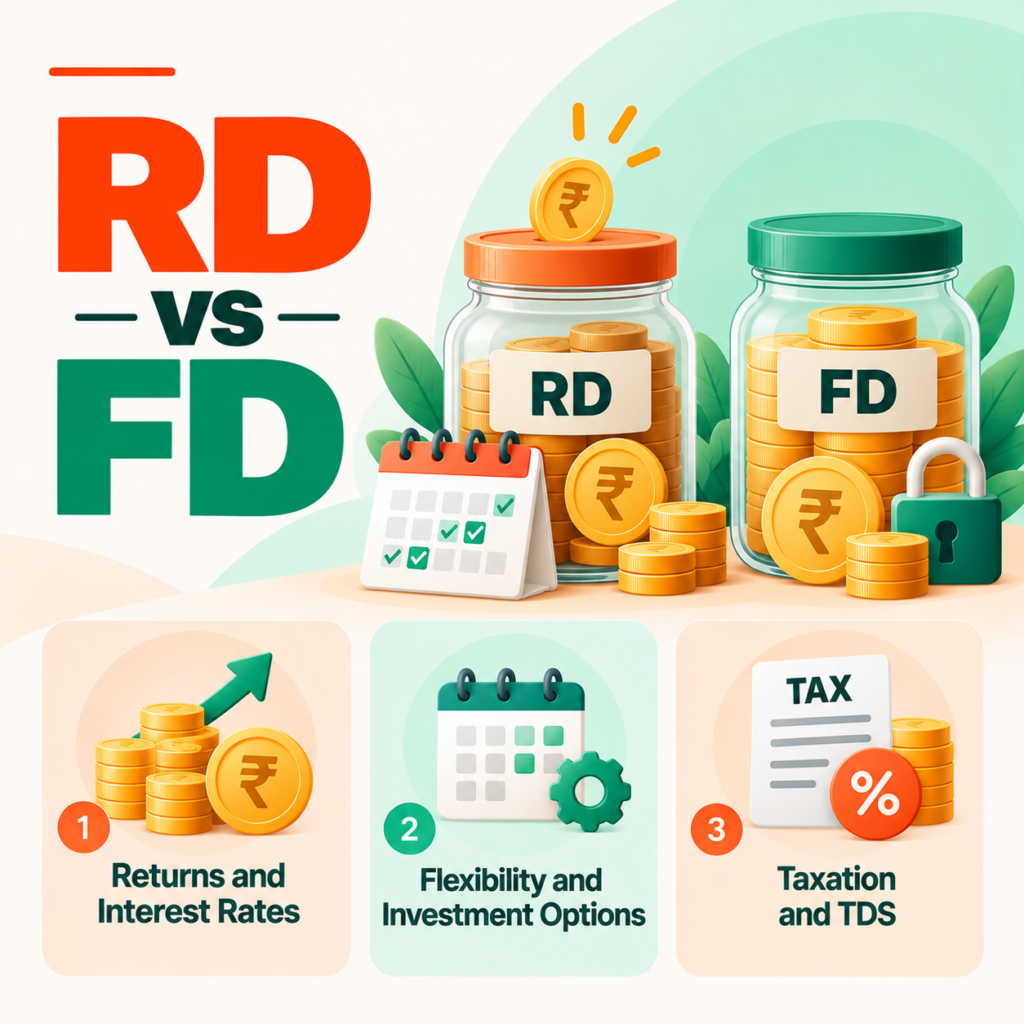
RD vs FD: Flexibility and Investment Options
Flexibility matters a lot when choosing a savings product. An RD requires a fixed monthly deposit. This builds discipline. However, it also means you must have a steady income to continue the plan.
An FD, meanwhile, offers more flexibility at the start. You choose the amount and the tenure once. After that, you do not need to make further deposits. This suits people who receive a bonus, gift, or lump sum amount.
Besides this, both RD and FD allow partial withdrawal in some banks, though a penalty usually applies. Similarly, both offer a loan facility against the deposit in many cases. This gives you access to funds without breaking your savings.
In short, choose an RD if you prefer monthly saving habits. Choose an FD if you already have a lump sum ready to invest.
RD vs FD: Risk and Safety
Both RD and FD are considered low-risk options. Banks insure deposits up to a certain limit under deposit insurance rules. As a result, your money stays protected even if the bank faces trouble.
Furthermore, neither RD nor FD depends on market performance. Unlike stocks or mutual funds, these products offer fixed, predictable returns. Therefore, they suit cautious savers who do not want to take risks.
However, inflation can reduce the real value of your returns over time. Meanwhile, this risk applies equally to both RD and FD. So, it is not a factor that favors one product over the other.
RD vs FD: Taxation and TDS
Interest earned from both RD and FD is taxable. It gets added to your total income and taxed as per your income slab. Besides this, banks deduct TDS, or Tax Deducted at Source, if your interest income crosses a set limit in a financial year.
Similarly, both RD and FD holders can submit Form 15G or Form 15H to avoid TDS, provided they meet the eligibility conditions. Moreover, this rule applies equally to both products. Therefore, taxation does not create a major difference between RD and FD.
As mentioned earlier, it is wise to plan your deposits across different financial years. This can help you manage your tax outgoings better.
RD vs FD: Which Is Better for Different Financial Goals?
Your financial goal plays a big role in this decision. Let us look at a few common situations.
If you want to build a habit of saving every month, an RD suits you well. It works great for short-term goals like a vacation, a gadget, or a small emergency fund.
If you already have a lump sum, such as a bonus or an inheritance, an FD makes more sense. It helps that money grow safely without needing further action from you.
Meanwhile, if you are saving for a long-term goal, such as a child’s education, you might use both. An FD can hold your existing savings, while an RD helps you add fresh monthly savings.
Besides this, retirees often prefer FDs for stable, regular income through interest payouts. On the other hand, young earners often prefer RDs to build saving discipline early in their careers.
Factors to Consider Before Choosing Between RD and FD
Before you decide, consider the following factors.
First, look at your income pattern. If you earn a steady salary, an RD can fit smoothly into your budget. If you have irregular income, an FD may suit you better since it needs only one deposit.
Second, check the interest rates offered by different banks. Even a small difference can matter over a long tenure.
Third, think about your goal and timeline. Short-term goals may suit an RD. Long-term goals may suit an FD, especially with a longer tenure.
Fourth, consider liquidity needs. If you may need funds urgently, check the premature withdrawal rules for both products.
Finally, taxation factor. As mentioned earlier, both RD and FD interest is taxable, so plan accordingly to avoid surprises.
RD vs FD: Pros and Cons
Let us summarise the advantages and disadvantages of both products.
RD Pros:
- Builds a regular savings habit
- Requires only a small monthly amount
- Suitable for short- and medium-term goals
RD Cons:
- Slightly lower interest rates than FD
- Requires steady monthly income
- Penalty for missed instalments in some banks
FD Pros:
- Usually offers higher interest rates
- Needs only one-time investment
- Flexible tenure options
FD Cons:
- Requires a lump sum upfront
- Premature withdrawal may attract a penalty
- Interest is taxable like RD
Overall, both products have their own strengths. Therefore, your choice should depend on your income, goal, and comfort level.
Conclusion
To sum up, RD vs FD is not about which product is better overall. It is about which product fits your situation. An RD suits regular savers who want to build a habit. An FD suits those with a lump sum ready to grow safely. To sell RDs orFDs, and earn good commission from them, join WeRize.
Moreover, you do not have to choose only one. Many people use both RD and FD together to balance discipline and growth. As a result, you get steady saving habits along with safe, lump-sum growth.
Besides this, always compare current interest rates before opening any account. Similarly, check the tenure and withdrawal rules of your chosen bank. This simple step can help you make a smarter, more informed decision.