English










More Indians want to save and invest today. However, most of them do not know where to start. As a result, this gap creates a great chance for you. If you enjoy money topics and love to help people, you can build your own advisory practice.
A self-employed financial consultant works for themselves. You choose your clients, your hours, and your income goals. Moreover, you do not need a big office or a large team to begin. In short, you need the right skills, the right registration and a clear plan.
In this guide, you will learn how to start, register, find clients,s and grow. Besides that, you will see the rules you must follow. So, let us begin.
What Is a Self-Employed Financial Consultant?
A self-employed financial consultant is a money expert who runs their own business. You do not work for a bank or a firm. Instead, clients pay you directly for your advice.
You may help a family plan for a child’s education. Similarly, you may help a young worker start a first SIP. Meanwhile, you may guide a retired person to build steady income.
To be clear, “financial consultant” is not a legal title in India. Still, the rules change when you give investment advice for a fee. In that case, you must follow SEBI rules. We will cover this in detail later.
What Does a Self-Employed Financial Consultant Do?
Your daily work depends on your clients. Nevertheless, most consultants do these tasks:
- Talk to clients and learn their money goals
- Review income, savings, loans, and expenses
- Build a simple financial plan
- Suggest suitable products, such as mutual funds or insurance
- Track the plan and update it every year
- Explain risks in plain words
In addition, you act as a guide and a teacher. Many clients feel scared of money choices. Therefore, your calm and clear advice builds trust fast.
Why Start a Financial Consultant Business in India?
A financial consultant business has strong demand right now. Here is why many people choose it.
1. Growing investor base. Every year, more people open demat accounts and start SIPs. Consequently, the need for trusted advice keeps rising.
2. Low starting cost. You can start from home. Besides, most of your work happens on calls and online.
3. Freedom and flexibility. You set your own schedule. Likewise, you decide how many clients you take.
4. Income that grows over time. Your earnings rise as your client list grows. Furthermore, happy clients bring referrals.
5. Meaningful work. Above all, you help families reach real goals, like a home or a safe retirement.
Skills and Qualifications Required
You need both hard skills and soft skills. First, let us look at the basics.
Skills You Need
- Money knowledge: Understand mutual funds, insurance, taxes,x and loans.
- Clear communication: Explain hard ideas in simple words.
- Listening: Hear what the client really wants.
- Honesty: Always put the client’s interest first.
- Basic tech skills: Use apps, sheets, and video calls with ease.
- Patience: Trust takes time to build.
Qualifications You Need
Please note that rules can change, so always check the latest SEBI notice. As of now, an individual who wants to register as an investment adviser needs the following:
- A graduate degree in a relevant field, such as finance, commerce, economics,s or management. A professional qualification in a similar area may also work.
- A valid NISM certification for investment advisers (NISM Series X-A and X-B).
- A minimum net worth, as set by SEBI for individual advisers.
Moreover, a course like CFP (Certified Financial Planner) is not compulsory. Nevertheless, it adds trust and improves your skills.
How to Become an Independent Financial Advisor in India
An independent financial advisor in India can work in two main ways. So, understand both before you choose.
| Route | What You Do | Who Regulates It | How You Earn |
| SEBI Registered Investment Adviser (RIA) | Give paid, unbiased advice and financial plans | SEBI | Fees from clients |
| Mutual Fund Distributor (MFD) | Sell and service mutual fund schemes | AMFI (under SEBI norms) | Commission from fund houses |
| Insurance Agent or POSP | Sell insurance policies | IRDAI | Commission from insurers |
Please note this key point. SEBI rules ask advisers to keep advice and distribution separate. Therefore, an RIA cannot take commissions on the same client in the way a distributor does. Before you choose a route, read the latest SEBI rules or speak to a compliance expert.
Meanwhile, many beginners start as a mutual fund distributor. Later, they move to the RIA route as their skills grow. The choice is yours.
Step-by-Step Guide to Starting a Financial Consultant Business
Follow these steps in order. Also, do not skip any step.
Step 1: Choose your niche. To begin, pick a group you want to serve. For example, you can serve young professionals, small business owners, rs or retired people. As a result, your message becomes clear and strong.
Step 2: Pick your business model. Decide whether you want to charge fees, earn commission, or do a mix under the right license. Then, check the rules for that model.
Step 3: Complete your education and exams. Enroll in the NISM exams you need. Similarly, sign up for a planning course if you want extra skills.
Step 4: Register your business. Choose a form, like a sole proprietorship or LLP. Next, apply for the licenses that fit your route.
Step 5: Open a business bank account. Keep personal and business money apart. Otherwise, your records will get messy.
Step 6: Set your fees and packages. Write down simple plans, such as a one-time plan or yearly review. Additionally, share your prices openly.
Step 7: Build your online presence. Make a simple website and a Google Business profile. Also, share useful tips on social media.
Step 8: Start with your first clients. Begin with friends, family, and colleagues. Then, ask them for referrals.
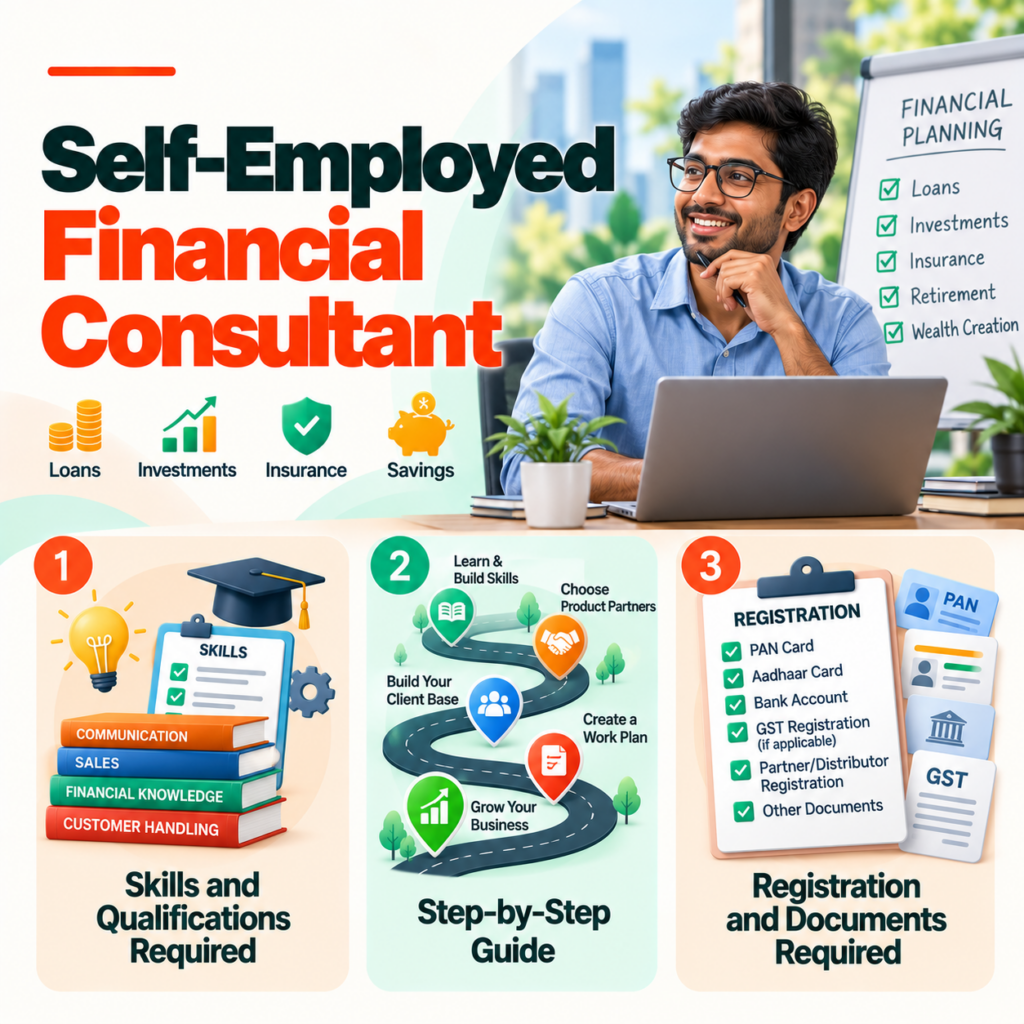
Registration and Documents Required
The exact list depends on your route. However, most people need these items:
- PAN card and Aadhaar card
- Proof of address
- Educational certificates
- NISM certificates
- Passport-size photos
- Net worth proof, if you apply as an RIA
- Bank account details
- Business registration papers (for example, GST, if it applies to you)
In addition, RIAs must follow SEBI rules on client agreements, risk profiling, and record-keeping. Above all, keep all files safe and up to date. Moreover, always use the official SEBI portal and check the current fee and process before you apply.
Financial Products You Can Offer Clients
The products you offer depend on your license. Broadly, you can work with these:
- Mutual funds: Equity, debt and hybrid schemes
- SIPs: Small, regular investments
- Insurance: Term, health and other plans
- Fixed income options: Bonds and deposits
- Retirement planning: NPS and long-term plans
- Tax planning: Tax-saving options under current rules
- Goal planning: Education, home and marriage funds
Remember, you must match every product to the client’s goal and risk level. Also, never promise fixed returns on market-linked products. That is unfair and against the rules.
How Self-Employed Financial Consultants Earn
Income depends on your model. Let us compare the common ones.
| Income Model | How It Works | Best For |
| Fee-only | Client pays a fixed fee for a plan or yearly service | RIAs who want unbiased advice |
| Assets-based fee | Fee is a share of the assets you advise on, within SEBI limits | RIAs with larger clients |
| Commission | Fund houses or insurers pay you when clients buy | Distributors and agents |
| Workshops and courses | People pay to learn money skills | Consultants who enjoy teaching |
At first, your income will start small. Nevertheless, it can grow steadily as you add clients. Furthermore, many consultants build a mix of income streams over time. Please avoid any promise of a fixed income figure, because results differ for every person.
How to Find and Build Your Client Base
In reality, clients will not appear on day one. Therefore, you must work on this every week.
- Start with your circle. Tell friends, family, and coworkers about your service.
- Ask for referrals. Happy clients love to share good names. Besides, referrals bring warm leads.
- Share useful content. Post short tips on LinkedIn, Instagram,m and YouTube. Similarly, write simple blogs like this one.
- Host free sessions. Run a small webinar or a talk in a local society.
- Use WhatsApp. Send helpful updates to people who agree to receive them. Also, reply quickly to every message.
- Partner with others. Work with chartered accountants, lawyers, Rs, and real estate agents. As a result, both sides get new leads.
- Collect reviews. Ask happy clients for honest feedback.
Above all, be patient. Trust brings clients, and trust comes from steady, honest work.
Tools to Manage Your Financial Consultant Business
Good tools save time. Consequently, you can spend more hours with clients.
- CRM tools: Track leads and follow-ups
- Financial planning software: Build plans and show goals in charts
- Risk profiling tools: Check a client’s comfort with risk
- Video call apps: Meet clients from anywhere
- E-sign tools: Sign agreements without paper
- Accounting apps: Track your income, bills, and GST
- Calendar apps: Book meetings and set reminders
For now, start with two or three tools. Then, add more as your business grows.
Common Challenges and Mistakes to Avoid
Of course, every new consultant faces hurdles. However, you can avoid many of them.
Slow start. Early months can feel quiet. Therefore, keep a savings buffer before you begin.
Ignoring rules. Breaking SEBI rules can lead to penalties. So, learn the rules first and follow them each day.
Overpromising. Never guarantee returns. Instead, explain risks in clear words.
Skipping documentation. Poor records cause trouble later. Hence, save every agreement and risk profile.
No niche. If you try to serve everyone, you may attract no one. Thus, choose a group and speak to them.
Selling instead of advising. Clients notice when you push products. Rather, focus on their goals.
Stopping your learning. Rules and markets change. Consequently, keep learning every year.
Tips to Grow Your Financial Consultant Business in 2026
- Go digital. More clients now want online meetings. Meanwhile, a simple website builds trust.
- Create short videos. Explain one money idea in one minute. Likewise, answer common questions.
- Focus on financial goals. Talk about a home, a child’s future, or a calm retirement. Moreover, people connect with goals more than with products.
- Review clients often. Equally important, meet them at least once a year. In addition, update plans after big life events.
- Build a personal brand. Share your story and your values. Similarly, keep your tone honest and warm.
- Add a disclaimer. Always state that investments carry market risk and past returns do not guarantee future results.
- Use simple language. Avoid jargon. Furthermore, explain every term.
Conclusion
In summary, becoming a self-employed financial consultant is a strong career move in 2026. First, pick your route and complete your exams. Next, register, set your fees, and start with a small client group. Then, grow through trust, content, and referrals. To become a loan agent, sell RD, FD & FD credit cards, & to earn more, join WeRize & start your DSA journey. Start small, stay patient, and grow steadily.
Moreover, follow every SEBI rule from day one. This protects your clients and your business. So, take the first step today. Choose your niche, sign up for your exam, and start your journey.